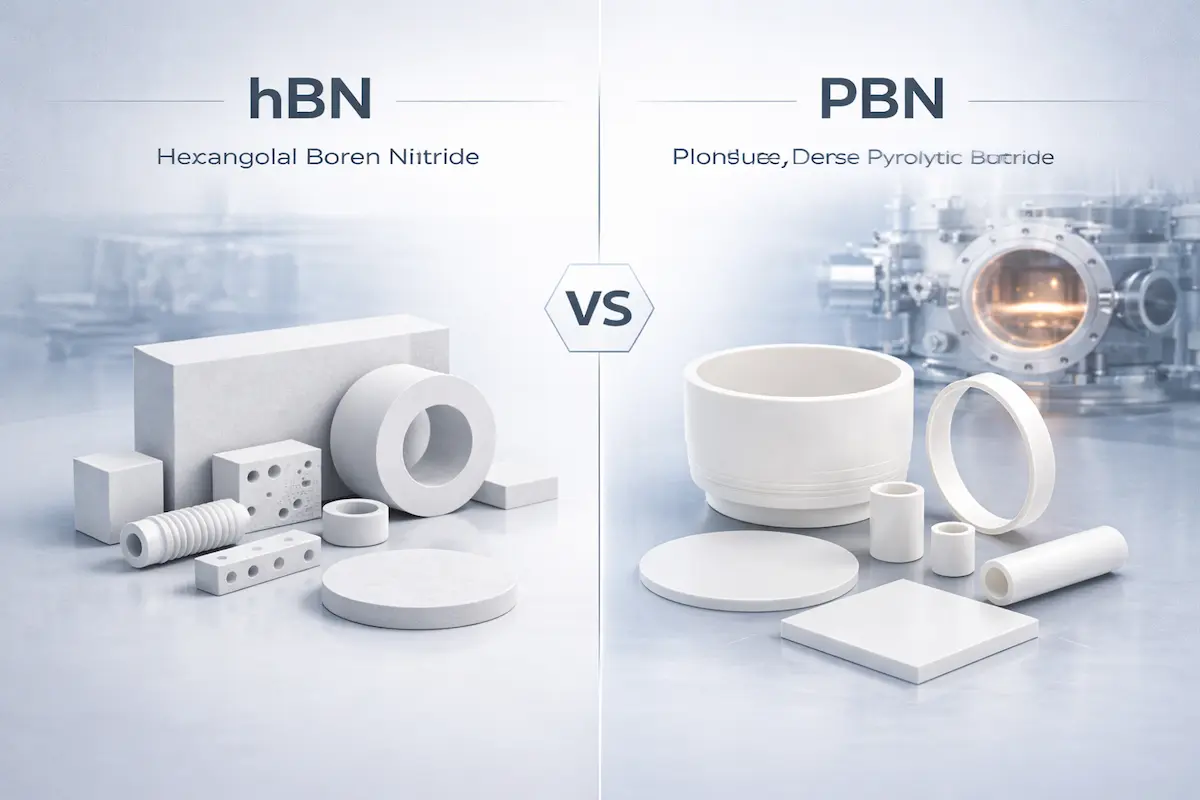
In most industrial applications, hBN is chosen for machinability, electrical insulation, thermal shock resistance, and lower cost. PBN is usually selected for ultra-high-purity, vacuum, semiconductor, and crystal-growth environments where contamination, outgassing, and process stability matter more than part price.
If your priority is custom geometry, faster fabrication, and cost control → hBN is often the practical choice.
If your priority is ultra-clean processing, vacuum compatibility, and directional thermal performance → PBN is usually the better fit.
Introduction
When engineers compare Hexagonal Boron Nitride vs Pyrolytic Boron Nitride, the real question is not which material sounds more advanced. The real question is which one reduces design risk, protects process stability, and delivers the right performance without overspending.
This is where many buyers, R&D teams, and OEM sourcing teams get stuck. Both materials are boron nitride. Both are electrical insulators. Both perform well in high-temperature environments. On paper, they can look similar enough to create confusion.
But in real projects, the difference between hBN and PBN is significant.
If the component is a custom-machined insulator, nozzle, spacer, furnace fixture, or molten-metal-contact part, hexagonal boron nitride often makes more commercial and engineering sense. If the part is used in semiconductor processing, vacuum systems, crystal growth, or other contamination-sensitive environments, pyrolytic boron nitride is often the safer selection.
So this is not a generic material comparison. It is a selection guide for engineers and buyers who need to balance cost, performance, purity, manufacturability, and reliability.
Why Buyers Compare hBN vs PBN in the First Place
Most buyers do not start by asking for boron nitride. They start with a problem:
- The part must survive high temperature without conducting electricity
- Standard ceramics are too difficult or too expensive to machine
- The system is sensitive to contamination or outgassing
- Thermal management matters, but so does chemical inertness
- The part sits inside an expensive process, so failure cost is much higher than part cost
That is why Hexagonal Boron Nitride vs Pyrolytic Boron Nitride becomes a real purchasing and engineering decision.
The pain point is usually one of these:
- You do not want to over-specify and pay for PBN when hBN is enough
- You do not want to under-specify and create contamination, yield loss, or reliability problems by using hBN where PBN is required
In other words, this choice affects both unit cost and total process cost.
Quick Comparison: Hexagonal Boron Nitride vs Pyrolytic Boron Nitride
| Property / Decision Factor | Hexagonal Boron Nitride (hBN) | Pyrolytic Boron Nitride (PBN) | Why It Matters |
|---|---|---|---|
| Manufacturing route | Typically hot-pressed from BN powder | Typically CVD-deposited | This affects purity, density, and structure |
| Structure | Machinable bulk ceramic | Dense, non-porous, anisotropic material | PBN behaves differently in thermal and vacuum environments |
| Purity | High, but grade-dependent | Ultra-high purity | PBN is preferred in contamination-sensitive systems |
| Porosity | Grade-dependent | Essentially non-porous | Important for vacuum and low outgassing |
| Machinability | Excellent | More specialized shaping route | hBN is usually better for custom-machined parts |
| Thermal conductivity | Moderate, grade- and direction-dependent | High in-plane, low through-thickness | PBN is useful when heat must spread laterally |
| Electrical insulation | Excellent | Excellent | Both are strong electrical insulators |
| Vacuum suitability | Good, depending on grade | Excellent | PBN is commonly preferred for vacuum processes |
| Cost | Lower | Higher | hBN often wins on budget |
| Typical applications | Insulators, nozzles, crucibles, spacers, furnace parts | Semiconductor components, crystal-growth parts, vacuum hardware | Application environment is often the deciding factor |
Quick Conclusion
hBN is usually the better choice for machinable, cost-effective engineering ceramic parts.
PBN is usually the better choice for high-purity, vacuum, semiconductor, and crystal-growth applications.
What Is the Core Difference Between hBN and PBN?
The biggest difference between hexagonal boron nitride and pyrolytic boron nitride is not the chemical formula. It is the material architecture created by the production method.
Hexagonal Boron Nitride (hBN)
In industrial use, hBN is usually supplied as a hot-pressed ceramic. It is known for:
- Easy machinability
- Good thermal shock resistance
- Strong electrical insulation
- Chemical inertness
- Non-wetting behavior with many molten metals and glasses
That is why hBN is widely used for custom ceramic parts where flexibility and cost matter.
Pyrolytic Boron Nitride (PBN)
PBN is usually made by chemical vapor deposition. This gives it:
- Ultra-high purity
- High density
- Very low porosity
- Low outgassing
- Strong anisotropy
That is why PBN is used where the material is part of the process environment itself, especially in vacuum, semiconductor, and crystal-growth systems.
What This Means in Practice
The selection logic is simple:
- If you need a practical engineering ceramic part → start with hBN
- If you need a process-grade material for a highly sensitive environment → start with PBN
Key Differences Explained
1) Thermal Conductivity
Thermal conductivity is one of the most misunderstood points in this comparison.
Some buyers assume “higher conductivity” automatically means “better material.” That is not true.
hBN
hBN offers useful thermal performance while maintaining electrical insulation. For many industrial parts, that is enough. The material can handle heat, reduce local thermal stress, and survive rapid temperature changes.
PBN
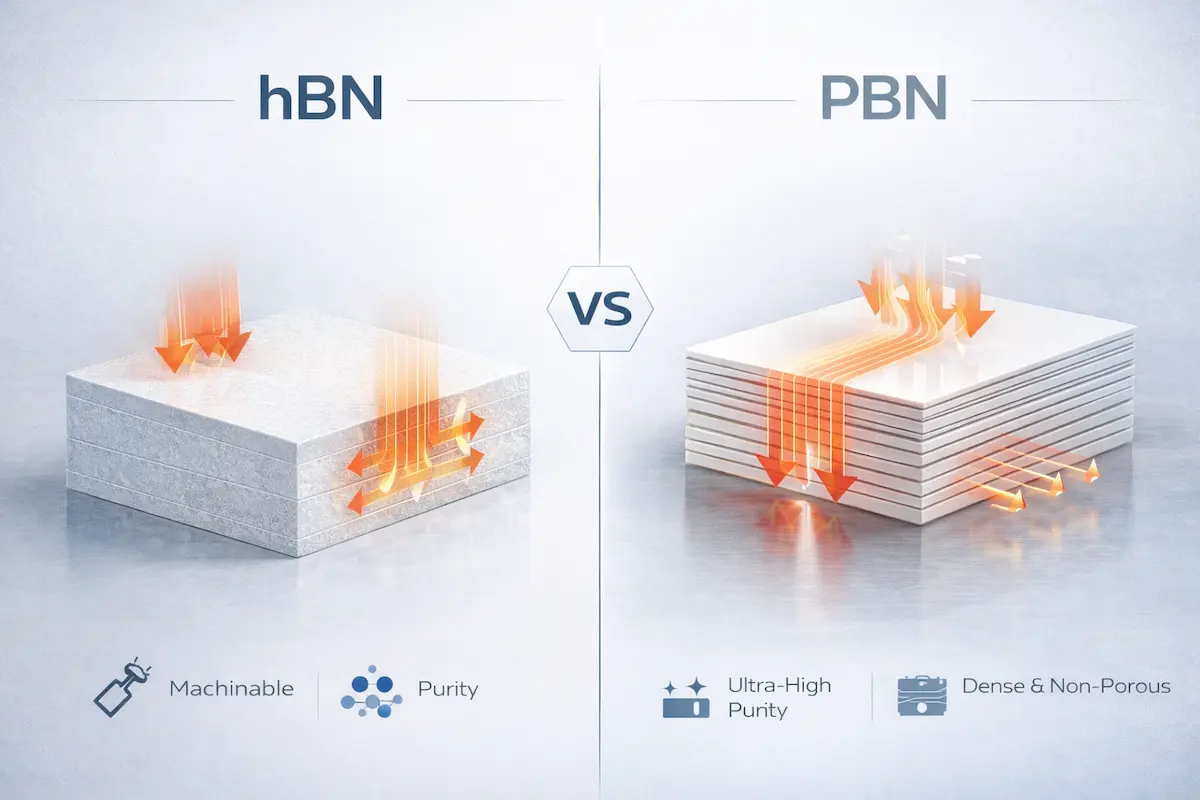
PBN is anisotropic. That means heat moves much more effectively in one direction than in another. This can be a major advantage for heat spreading along a plane, but it can also become a design mistake if the thermal path is through thickness instead.
Engineering Meaning
- If you need general thermal management with insulation → hBN may be sufficient
- If you need directional heat spreading → PBN may be a better fit
- If you assume PBN is always thermally superior in every direction → you may choose the wrong material
Selection Conclusion
If thermal directionality matters, review PBN carefully. If you need a more practical all-around insulating ceramic, hBN is often enough.
2) Purity and Contamination Control
This is where PBN often justifies its higher price.
hBN
hBN can be highly pure, but purity depends on the grade and production route. For many industrial uses, that is not a problem.
PBN
PBN is typically selected when contamination risk must be minimized. Its dense, non-porous structure and high purity make it especially suitable for semiconductor and vacuum-related use.
Engineering Meaning
If the part is near wafers, crystal growth zones, sensitive thin films, or high-value processing environments, contamination becomes a process risk, not just a material property.
Selection Conclusion
If contamination control is critical, PBN usually deserves priority.
3) Machinability and Customization
For many buyers, this is the first commercial filter.
hBN
hBN is known for excellent machinability. It can be made into custom shapes, prototypes, and small-batch parts more easily than many advanced ceramics.
PBN
PBN is more specialized. It is valuable in high-end applications, but it is not usually the first choice when the project needs fast custom machining at controlled cost.
Buyer Meaning
If your project includes frequent drawing changes, prototype revisions, or low-volume custom geometry, hBN often gives a smoother sourcing path.
Selection Conclusion
If your priority is custom machining, short lead-time development, and cost efficiency, choose hBN first.
4) Reliability in High-Temperature and Vacuum Systems
Both materials are used in demanding thermal environments, but not for the same reasons.
hBN
hBN performs well in inert and controlled high-temperature environments. It is especially valued where thermal shock resistance and insulation are needed.
PBN
PBN is often preferred in vacuum systems and high-purity process hardware because it combines thermal capability with low outgassing and low contamination risk.
Buyer Meaning
If the cost of process instability is high, PBN may save more money than it costs.
Selection Conclusion
If the part sits inside a high-value vacuum or semiconductor process, PBN is often the lower-risk choice.
5) Cost vs Performance
This is usually where procurement and engineering must align.
hBN
hBN is usually the lower-cost option and often delivers enough performance for industrial parts, insulating components, and custom ceramic assemblies.
PBN
PBN costs more, but the cost is often justified when the part protects process yield, purity, and repeatability.
Trade-Off Logic
- If the application is industrial and functional → hBN often offers the best value
- If the application is process-critical and contamination-sensitive → PBN may offer the better total cost of ownership
Selection Conclusion
Do not compare only part price. Compare failure cost, contamination risk, downtime risk, and replacement complexity.
Application-Based Comparison: How Engineers Actually Choose
Semiconductor Processing
In semiconductor, epitaxy, MBE, MOCVD, and crystal-growth environments, material cleanliness is often more important than part cost.
Why choose PBN?
- Higher purity
- Low outgassing
- Dense structure
- Better fit for contamination-sensitive processes
Recommendation:
If your application is near wafers, films, or crystal growth → choose PBN unless there is a clear reason not to.
General Industrial Insulation Parts
For furnace hardware, insulating fixtures, spacers, supports, and custom nozzles, the practical advantages of hBN often matter more.
Why choose hBN?
- Easier to machine
- Lower cost
- Good thermal shock resistance
- Strong electrical insulation
Recommendation:
If the design needs custom-machined high-temperature insulating parts → hBN is often the first material to evaluate.
Molten Metal and Non-Wetting Applications
Many buyers choose boron nitride because of its non-wetting behavior.
Why choose hBN?
- Common for nozzles, crucibles, and molten metal contact components
- More economical for many industrial uses
- Easier to fabricate into custom shapes
Recommendation:
If your main goal is non-wetting performance with reasonable cost → hBN is usually the more practical choice.
Vacuum and UHV Hardware
Vacuum environments raise the cost of material mistakes.
Why choose PBN?
- Better fit for low outgassing conditions
- Cleaner material structure
- More suitable for highly sensitive thermal-vacuum environments
Recommendation:
If vacuum purity matters more than part price → choose PBN.
Common Buyer Pain Points
“The two materials look similar in basic product descriptions.”
Yes, and that is exactly why wrong selection happens. Many generic descriptions focus only on “high temperature,” “electrical insulation,” and “chemical resistance.” Those are not enough for proper selection.
“We do not know whether our application really needs PBN.”
This is common. Many projects do not need PBN. But if your process is high-purity, vacuum-based, or yield-sensitive, choosing hBN only because it is cheaper can create a much bigger hidden cost later.
“We need custom parts, but we cannot afford repeated trial-and-error.”
That usually points toward hBN for early-stage prototyping, unless the actual operating environment clearly requires PBN from the start.
“Procurement wants lower cost, engineering wants lower risk.”
This is the real trade-off. The best decision is usually the one that aligns material grade with process sensitivity, not the one with the lowest nominal part price.
Common Mistakes in hBN vs PBN Selection
Mistake 1: Treating hBN and PBN as interchangeable
They are not. Similar chemistry does not mean similar process suitability.
Mistake 2: Comparing only catalog properties
A datasheet does not show contamination risk, outgassing concerns, or the cost of downtime.
Mistake 3: Choosing PBN for every premium-looking application
PBN is not automatically the better option. In many industrial applications, it is simply over-specified.
Mistake 4: Choosing hBN only because it is cheaper
If the part affects yield, purity, or vacuum stability, the cheaper part can become the expensive mistake.
Mistake 5: Ignoring thermal direction
PBN’s anisotropy is an advantage only when it matches the actual heat-flow requirement.
What Happens If You Choose the Wrong Material?
Wrong selection here often causes quiet failure before visible failure.
That means:
- Lower process yield
- Unexpected contamination
- Unstable thermal behavior
- Shorter maintenance cycles
- Repeated redesign
- Procurement delays from requalification
If you choose hBN when PBN is actually required:
You may reduce initial part cost but increase contamination risk, instability, and process uncertainty.
If you choose PBN when hBN is already enough:
You may pay more, complicate sourcing, and extend approval cycles without gaining real performance value.
The real risk is not just material mismatch. It is system-level inefficiency.
Pros and Limitations
Hexagonal Boron Nitride (hBN)
Advantages
- Excellent machinability
- Lower cost
- Strong electrical insulation
- Good thermal shock resistance
- Useful non-wetting behavior
- Better for custom shapes and prototypes
Limitations
- Grade-dependent purity
- Not ideal for every ultra-clean process
- May be insufficient for the most contamination-sensitive environments
- Thermal behavior must still be checked against the actual application
Pyrolytic Boron Nitride (PBN)
Advantages
- Ultra-high purity
- Dense and non-porous
- Strong for vacuum and semiconductor environments
- Low outgassing
- Useful directional thermal performance
Limitations
- Higher cost
- More specialized sourcing
- Not always necessary for general industrial ceramic parts
- Anisotropy requires correct design understanding
How to Choose Between Hexagonal Boron Nitride and Pyrolytic Boron Nitride
Practical Decision Logic
| If your priority is… | Choose | Why |
|---|---|---|
| Lower cost and easier fabrication | hBN | Better machinability and broader practicality |
| Ultra-high purity | PBN | Better for contamination-sensitive environments |
| Vacuum compatibility | PBN | Lower outgassing and denser structure |
| Custom geometry or prototyping | hBN | Easier to machine and revise |
| General electrical insulation | hBN | Usually sufficient and more economical |
| Directional heat spreading | PBN | Better when thermal directionality matters |
| Molten metal non-wetting parts | hBN | Practical and cost-effective |
| Semiconductor or crystal-growth hardware | PBN | Better process stability and purity |
Recommendation Logic
- If cost is limited and the environment is not ultra-clean → choose hBN
- If vacuum compatibility is critical → choose PBN
- If your main concern is fast custom machining → choose hBN
- If your process is contamination-sensitive → choose PBN
- If you are unsure whether the process risk justifies PBN → start by reviewing purity requirements, outgassing tolerance, and failure cost, not just material price
- If long-term reliability in a high-value process matters more than initial part cost → PBN often becomes the safer recommendation
- If the project is an industrial fixture, insulating component, or custom machined part → hBN is often the more commercially sensible option
Quick Recommendation
There is no universal winner in Hexagonal Boron Nitride vs Pyrolytic Boron Nitride.
Choose hBN when you need a practical, machinable, lower-cost ceramic for high-temperature insulation, custom components, nozzles, spacers, and non-wetting applications.
Choose PBN when the application is closer to semiconductor, vacuum, crystal growth, or any environment where purity, low outgassing, and contamination control are more important than upfront material cost.
A useful rule is this:
- If the part is mainly a component → hBN is often enough
- If the part is part of the process itself → PBN often deserves serious priority
Soft CTA
If you are selecting between hBN and PBN for a custom ceramic substrate, insulator, crucible, heater component, or vacuum-related part, it is usually worth reviewing the drawing, operating temperature, atmosphere, contamination tolerance, and fabrication method before locking the material.
In many cases, a short material selection review can quickly determine whether you need the purity and vacuum performance of PBN or whether a well-matched hBN grade will deliver the better cost-to-performance balance.
FAQ
1. What is the main difference between hexagonal boron nitride and pyrolytic boron nitride?
The main difference is that hBN is typically a hot-pressed machinable ceramic, while PBN is a CVD-deposited ultra-high-purity, dense, non-porous material. That difference affects purity, machinability, thermal behavior, and application suitability.
2. Which is better for vacuum applications, hBN or PBN?
PBN is usually better for vacuum applications because it is more suitable for ultra-clean, low-outgassing environments. hBN can still work in some vacuum-related uses, but PBN is usually preferred where contamination risk is critical.
3. Which is easier to machine, hBN or PBN?
hBN is usually easier to machine and more practical for custom components, prototypes, and complex shapes.
4. Is PBN always better than hBN?
No. PBN is not automatically better. It is better only when the application truly requires higher purity, lower porosity, vacuum compatibility, or process-grade cleanliness. In many industrial uses, hBN is the better value choice.
5. When should I choose hBN instead of PBN?
Choose hBN when you need electrical insulation, thermal shock resistance, custom machining, non-wetting behavior, and lower overall cost, especially for general industrial parts rather than ultra-clean semiconductor or vacuum systems.