Introduction
Ceramic parts are precision components manufactured from advanced ceramic materials such as alumina, zirconia, silicon nitride, silicon carbide, aluminum nitride, and machinable glass ceramics. They are selected for applications that require a specific combination of hardness, thermal stability, chemical resistance, dielectric performance, or low deformation under load and temperature.
This topic matters because ceramic components often sit at the failure boundary of a system. A wrong material choice can lead to cracking during assembly, dielectric breakdown in electronics, premature wear in pumps, contamination in semiconductor tools, or thermal mismatch in high-power modules. For engineers, ceramic parts are not a niche material topic; they are often a reliability and performance decision. For buyers and OEM teams, they also affect manufacturability, lead time, inspection criteria, and total ownership cost.
This guide explains what ceramic parts are, why they matter, the main material types, the performance parameters that drive selection, the trade-offs between common ceramics, and where these parts are used in real industrial systems. It is written as a decision-oriented pillar page, not as a generic introduction.
What Are Ceramic Parts?
Ceramic parts are functional components made from engineered inorganic, non-metallic materials that are shaped, sintered, and finished to meet mechanical, electrical, thermal, or chemical requirements.
Unlike decorative ceramics or conventional pottery, technical ceramic parts are designed for performance. They may serve as:
- electrical insulators
- wear components
- precision positioning elements
- sealing and valve parts
- thermal management components
- high-temperature fixtures
- corrosion-resistant flow path parts
- substrate or packaging components in electronics
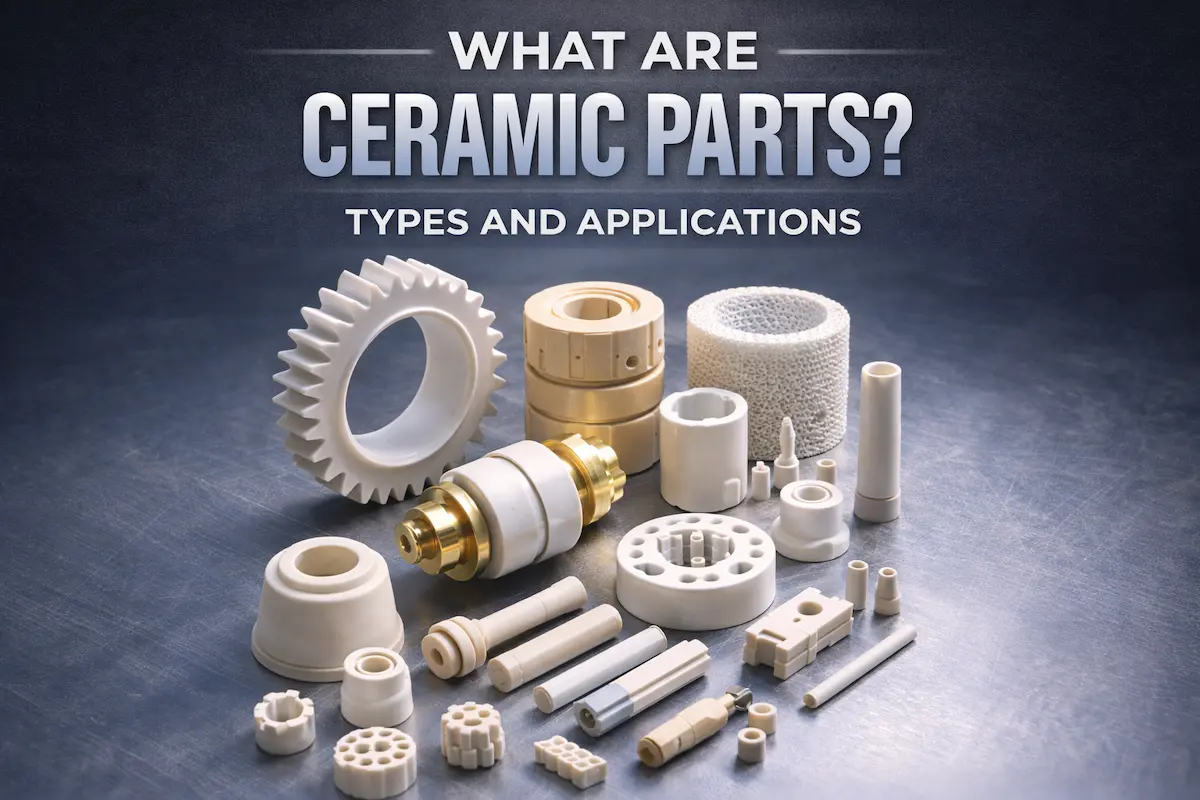
Common examples include ceramic tubes, rods, rings, washers, nozzles, plungers, valve seats, guide rollers, pins, bushings, insulators, crucibles, and custom ceramic components used in OEM assemblies.
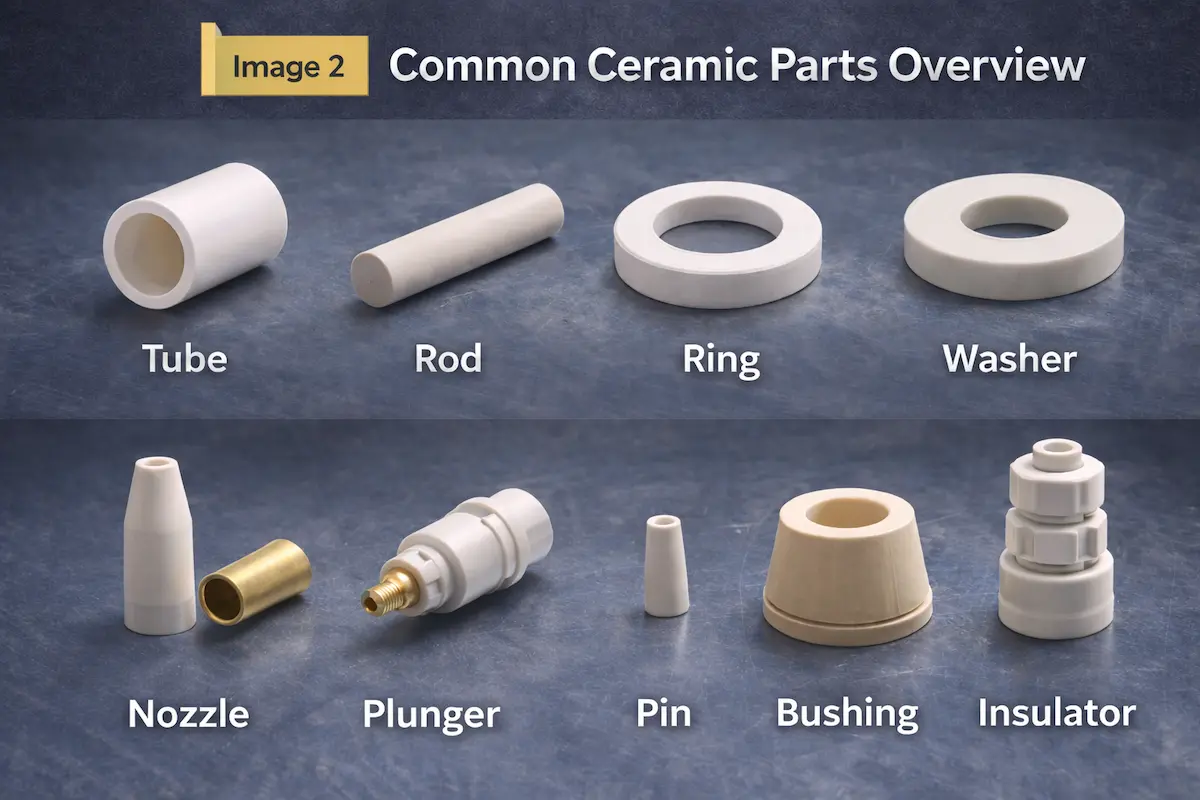
The practical definition is simple: a ceramic part is chosen when the application demands properties that standard metals or polymers cannot provide at the same operating condition.
Why Ceramic Parts Are Different from Standard Industrial Parts
A metal part is usually selected around strength, ductility, machinability, and cost. A ceramic part is selected around property retention under harsh conditions.
Ceramics offer advantages such as:
- high hardness and wear resistance
- high compressive strength
- excellent electrical insulation or, in some cases, thermal conductivity with insulation
- corrosion and oxidation resistance
- stability at elevated temperature
- low thermal expansion in selected materials
- low contamination for clean processes
The trade-off is that ceramics are less forgiving under impact, misalignment, and tensile stress concentration. Their use requires better design discipline, tighter tolerance planning, and a material-process-fit mindset.
Conclusion: Ceramic parts are engineering components used when reliability depends on stable performance in heat, wear, voltage, corrosion, or precision-critical conditions.
Why Ceramic Parts Matter in Engineering and Procurement
Ceramic parts matter because they solve failure modes that are difficult to eliminate by geometry change alone.
From the Engineering View
Engineers focus on function and failure risk. Ceramic parts are often introduced to address one or more of these problems:
- metal parts wear too fast
- polymers creep or degrade under heat
- electrical leakage causes reliability issues
- corrosion shortens service life
- dimensional drift affects alignment or sealing
- thermal shock or hot-spot conditions exceed standard material limits
For example, an alumina insulator in a high-voltage assembly is not just a spacer. It controls creepage performance, dielectric integrity, and thermal aging behavior. A silicon nitride bearing element is not just hard; its low density and rolling contact behavior may improve speed and wear performance. A zirconia blade or plunger is not just corrosion resistant; it may also reduce galling and contamination.
From the Procurement View
Procurement teams need to care about ceramic parts for a different reason: specification quality strongly affects sourcing success.
A ceramic RFQ that only says “ceramic ring” is incomplete. Buyers usually need to define:
- material grade
- density or purity level where relevant
- dimensions and tolerances
- surface finish
- flatness, parallelism, concentricity, or runout if critical
- working environment
- inspection requirements
- volume and repeatability expectations
This is why collaboration between engineering, quality, and the ceramic substrate manufacturer or component supplier matters early. Ceramic sourcing is rarely just a price comparison exercise.
Conclusion: Ceramic parts deserve attention because they are often selected to control system risk, and their procurement quality depends heavily on specification discipline.
Types of Ceramic Parts by Material
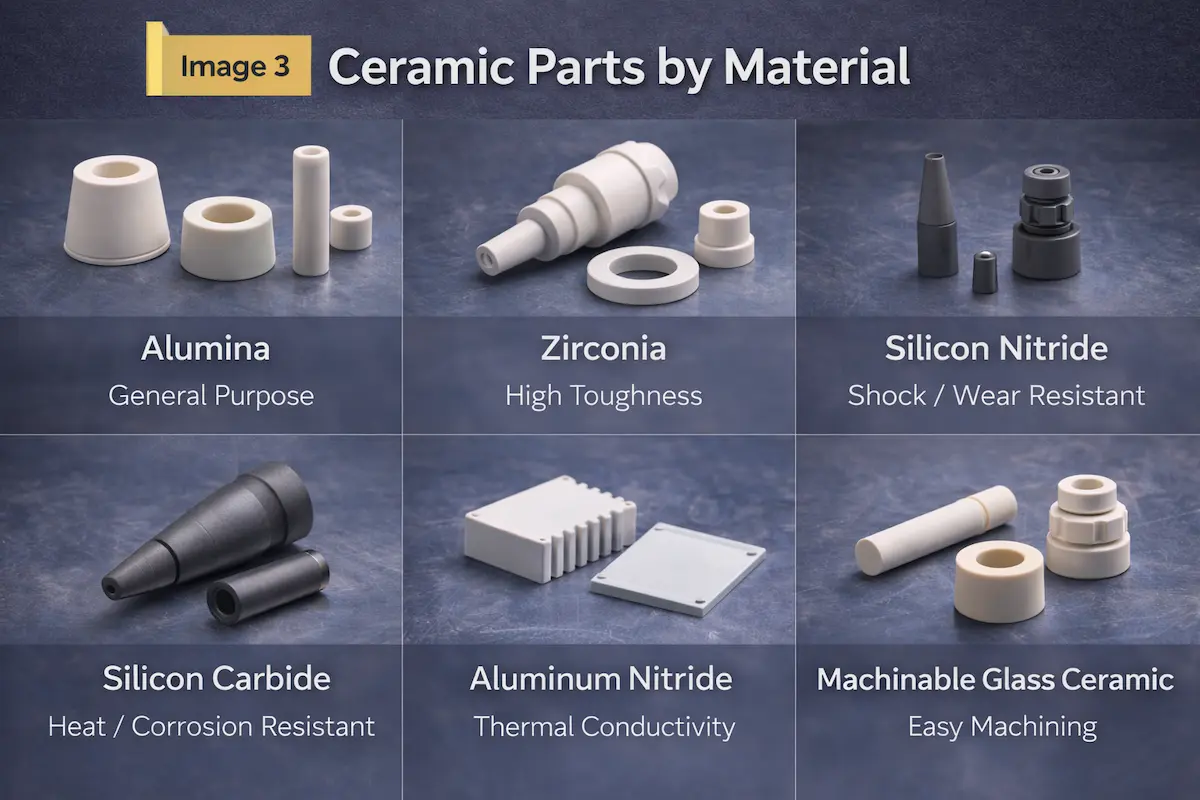
The most useful way to classify ceramic parts is by material family, because application fit depends more on material behavior than on shape alone.
1. Alumina Ceramic Parts
Alumina is one of the most widely used technical ceramics due to its balance of electrical insulation, hardness, wear resistance, and cost control.
Typical uses:
- electrical insulators
- wear sleeves
- guide components
- vacuum components
- pump seals
- ceramic substrate-related support parts
Strengths:
- good electrical insulation
- high hardness
- strong corrosion resistance
- mature manufacturing base
- broad cost-performance range
Limits:
- lower fracture toughness than zirconia
- moderate thermal conductivity
- not ideal for severe thermal shock compared with some non-oxide ceramics
2. Zirconia Ceramic Parts
Zirconia is valued for high toughness, good strength, and fine surface finish capability.
Typical uses:
- blades
- plungers
- valve components
- precision wear parts
- medical or fluid-handling components
- components requiring better crack resistance than alumina
Strengths:
- higher fracture toughness than many ceramics
- good wear resistance
- high strength
- smooth finished surfaces possible
Limits:
- lower thermal conductivity
- phase stability considerations depending on grade and use temperature
- generally higher cost than standard alumina
3. Silicon Nitride Ceramic Parts
Silicon nitride is used where strength, thermal shock resistance, and dynamic reliability are required.
Typical uses:
- bearings
- welding pins
- turbo-related parts
- molten metal handling
- high-speed mechanical components
Strengths:
- high strength-to-weight ratio
- excellent thermal shock resistance
- good wear performance
- strong reliability in dynamic service
Limits:
- higher material and manufacturing cost
- more specialized processing
4. Silicon Carbide Ceramic Parts
Silicon carbide is known for hardness, temperature capability, wear resistance, and thermal conductivity.
Typical uses:
- mechanical seals
- kiln furniture
- semiconductor process parts
- heat management parts
- abrasion-resistant liners and nozzles
Strengths:
- very high hardness
- excellent wear and corrosion resistance
- high thermal conductivity in many grades
- strong high-temperature performance
Limits:
- brittle behavior requires careful design
- finishing can be demanding
- some grades are more difficult to machine post-sintering
5. Aluminum Nitride Ceramic Parts
Aluminum nitride is mainly chosen for its combination of high thermal conductivity and electrical insulation.
Typical uses:
- heat spreaders
- electronic packages
- insulating thermal management parts
- power electronics components
Strengths:
- high thermal conductivity
- electrical insulation
- suitable for heat-intensive electronic environments
Limits:
- usually more expensive than alumina
- handling and processing conditions must be controlled carefully
6. Machinable Glass Ceramic Parts
Machinable glass ceramic is used for prototypes, low-volume precision parts, and electrical or thermal insulation applications where fast machining is important.
Typical uses:
- lab fixtures
- insulating structures
- prototype housings
- vacuum system components
Strengths:
- can be machined with conventional tools
- good dimensional flexibility
- useful for rapid development cycles
Limits:
- lower mechanical performance than dense structural ceramics
- not suitable for the most demanding wear environments
Conclusion: The main material families of ceramic parts each solve different engineering problems. Material selection should begin with failure mode, not with habit or familiarity.
Key Properties That Define Ceramic Parts Performance
The following parameters are the most important in selecting ceramic parts. A property only matters if it connects to a real service condition.
Structured Property Table for Common Ceramic Materials
| Material | Density (g/cm³) | Hardness | Thermal Conductivity (W/m·K) | Electrical Insulation | Fracture Toughness | Typical Value Position |
|---|---|---|---|---|---|---|
| Alumina | 3.7–3.9 | High | 20–30 | Excellent | Moderate-low | Balanced, cost-effective |
| Zirconia | 5.7–6.1 | High | 2–3 | Excellent | High for ceramics | Tough, precision wear |
| Silicon Nitride | 3.2–3.3 | High | 20–30 | Good | High | Dynamic, thermal shock resistant |
| Silicon Carbide | 3.1–3.2 | Very high | 80–200+ | Grade-dependent | Moderate | Heat, wear, corrosion |
| Aluminum Nitride | 3.3 | Moderate-high | 140–180+ | Excellent | Moderate | Thermal management |
| Machinable Glass Ceramic | 2.5–2.7 | Moderate | 1–2 | Good | Low-moderate | Prototype, insulator |
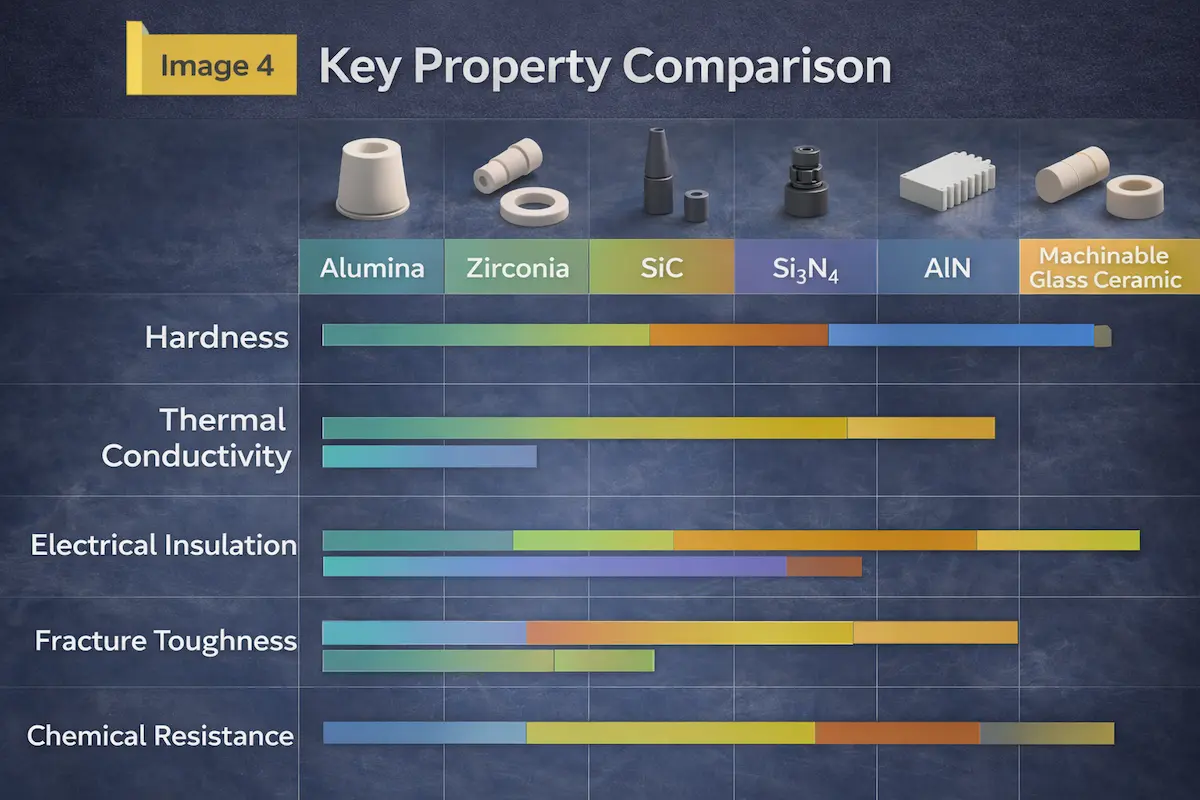
Why These Parameters Matter
Hardness
Hardness affects wear resistance, scratch resistance, and surface durability. It is important for seals, nozzles, bushings, and sliding contact parts. High hardness helps, but hardness alone does not guarantee longer life if the part sees impact or edge chipping.
Fracture Toughness
This measures resistance to crack propagation. It matters for installation handling, assembly stress, shock loading, and thin-section designs. A tougher ceramic such as zirconia may outperform a harder ceramic in edge-sensitive parts.
Thermal Conductivity
This matters in heat dissipation and thermal gradient control. It is critical in power electronics, heaters, semiconductor tools, and thermal interface structures. This is why aluminum nitride and silicon carbide are often considered in heat-management roles.
Electrical Insulation
This matters where the part must prevent current leakage while surviving heat or contamination. Alumina and aluminum nitride are strong choices for many electrically insulating ceramic components.
Coefficient of Thermal Expansion (CTE)
CTE affects dimensional compatibility with metals, solders, brazes, and semiconductor materials. A mismatch may create residual stress and cracking during thermal cycling.
Chemical Resistance
This matters in acids, alkalis, solvents, plasma, moisture, and clean-process environments. Material selection here depends on the actual media, temperature, and exposure duration.
Conclusion: The right ceramic part is selected by matching the dominant failure risk to the property that controls it.
Ceramic Parts Comparison: How Common Materials Differ
A direct comparison helps narrow material options before detailed design review.
Comparison Table: Material Trade-Offs
| Material | Main Advantage | Main Limitation | Best-Fit Applications | Poor Fit Scenarios |
|---|---|---|---|---|
| Alumina | Strong all-around performance and supply maturity | Lower toughness than zirconia | Insulators, wear parts, standard industrial ceramics | Repeated impact or severe thermal shock |
| Zirconia | High toughness and strength | Lower thermal conductivity, higher cost | Precision wear parts, plungers, blades, fluid parts | High-heat dissipation roles |
| Silicon Nitride | Excellent thermal shock and dynamic performance | Higher cost and process complexity | Bearings, welding fixtures, high-speed components | Budget-driven standard parts |
| Silicon Carbide | Extreme hardness, corrosion resistance, heat capability | Brittle design margin, difficult finishing | Seals, semiconductor parts, abrasion parts | Thin fragile parts with poor load distribution |
| Aluminum Nitride | High thermal conductivity with insulation | Higher material cost | Heat spreaders, electronic ceramic parts | General wear applications |
| Machinable Glass Ceramic | Fast machining and prototyping | Lower structural strength | Low-volume fixtures, lab and insulation parts | Heavy wear or high-load service |
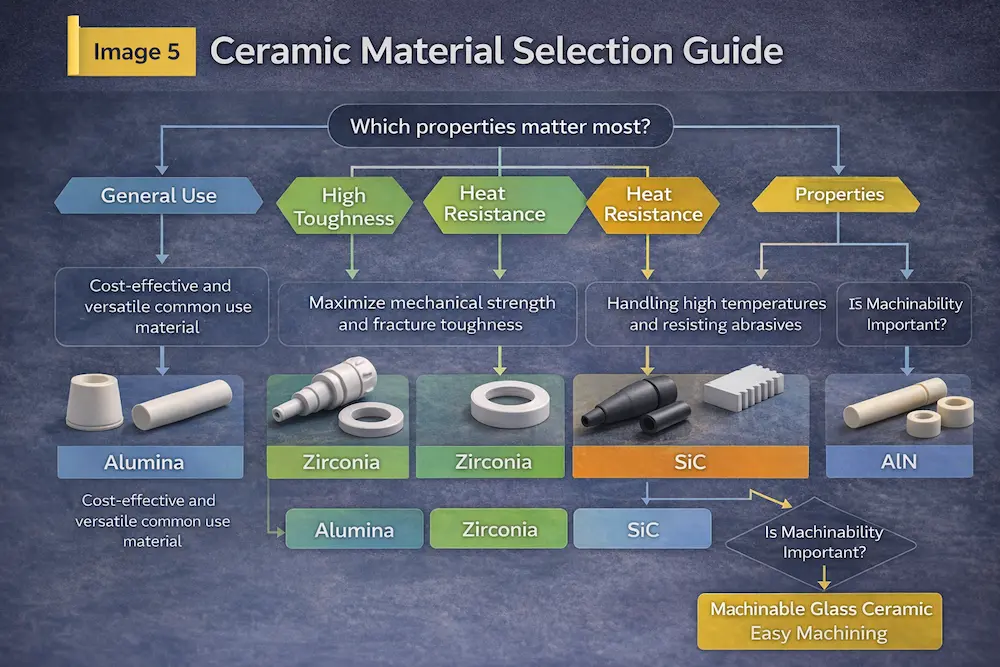
Conclusion: No ceramic material is “best” in general. The correct choice depends on whether the primary problem is wear, heat, voltage, chemical attack, or cracking risk.
Types of Ceramic Parts by Function
Material is one way to classify ceramic parts. Another useful approach is by job function.
Insulating Ceramic Parts
These isolate voltage and control leakage paths.
Examples:
- spacers
- insulator tubes
- terminal bodies
- feedthrough-related parts
Wear-Resistant Ceramic Parts
These resist abrasion, sliding wear, and erosion.
Examples:
- bushings
- guide rollers
- nozzles
- sleeves
- liners
Structural Precision Ceramic Parts
These maintain shape, alignment, or dimensional accuracy.
Examples:
- pins
- plates
- positioning fixtures
- metrology supports
Thermal Management Ceramic Parts
These transfer or contain heat without losing dielectric function.
Examples:
- heat spreaders
- insulating carriers
- power module support parts
Chemical and Process Ceramic Parts
These survive corrosive or high-purity environments.
Examples:
- crucibles
- seal faces
- pump components
- semiconductor handling parts
This functional classification is helpful when discussing requirements with OEM ceramic solutions providers or internal design teams, because it ties material choice to part purpose.
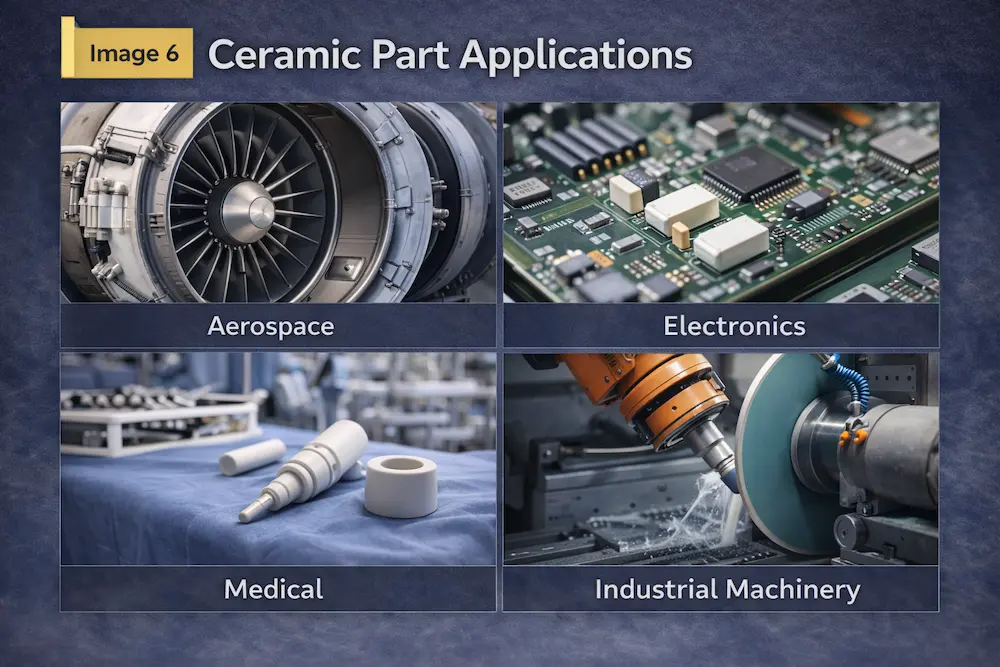
Applications of Ceramic Parts in Real Industrial Systems
Ceramic parts appear across many industries because the performance gap between ceramics and conventional materials is large in harsh environments.
Electronics and Electrical Systems
In electronics, ceramic parts are used for insulation, thermal control, and package stability.
Examples:
- insulators
- substrate carriers
- heat spreaders
- sensor housings
- high-voltage supports
This is also where the connection to a ceramic substrate manufacturer becomes relevant. Some assemblies use ceramic substrates directly, while others use additional ceramic structural parts around the substrate, housing, or power module.
Semiconductor and Vacuum Equipment
Semiconductor tools require low contamination, plasma resistance, thermal stability, and precision.
Examples:
- wafer handling components
- chamber liners
- insulators
- process spacers
- high-purity flow path parts
Pumps, Valves, and Fluid Control
Ceramic parts improve service life in abrasive or corrosive media.
Examples:
- plungers
- valve seats
- seal rings
- nozzles
- pump sleeves
Zirconia and silicon carbide are common in these applications depending on wear mode, fluid chemistry, and thermal conditions.
Automotive and Mobility
Advanced ceramics are used in sensors, electrical systems, wear points, and high-temperature functions.
Examples:
- sensor insulators
- precision wear components
- turbo-related ceramics
- EV power electronics thermal components
Industrial Machinery
Ceramic parts support higher uptime in equipment exposed to friction, particle wear, temperature, or electrical stress.
Examples:
- guide components
- cutting aids
- bearings
- rollers
- insulating assemblies
Medical and Analytical Equipment
Where cleanliness, corrosion resistance, precision, or electrical insulation matters, ceramics are common.
Examples:
- pump components
- measurement fixtures
- insulating parts
- wear-resistant precision elements
Conclusion: Ceramic parts are used where operating conditions punish standard materials. Their value is highest when downtime, contamination, or reliability loss costs more than the part itself.
How to Choose Ceramic Parts for an Application
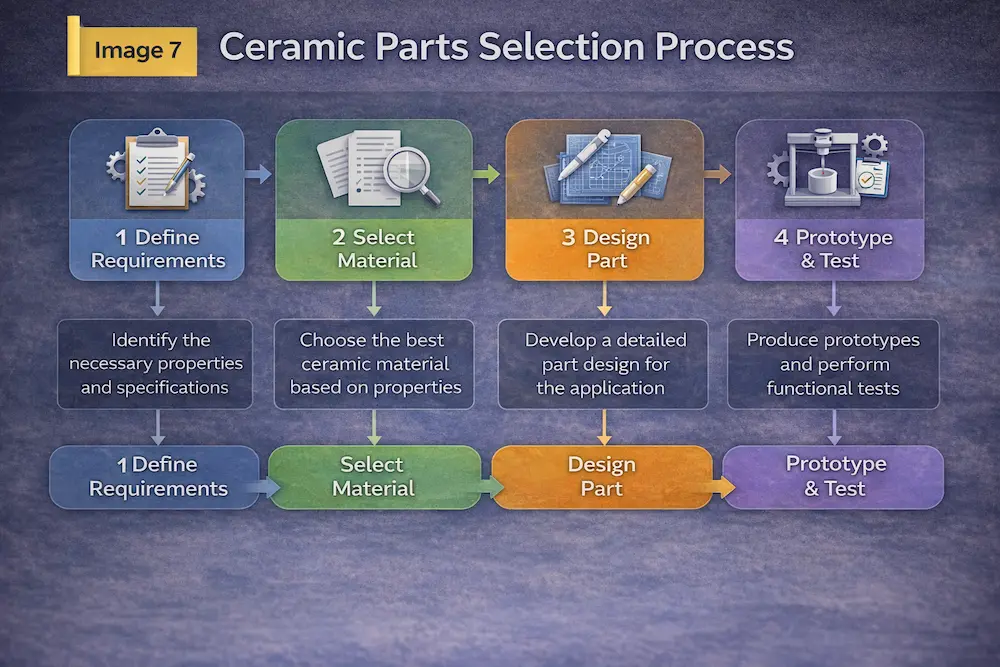
Selection should start from application failure mode, then move to material screening, geometry review, and manufacturing feasibility.
Step 1: Define the Primary Functional Requirement
Ask which property is non-negotiable:
- electrical insulation
- thermal conductivity
- wear resistance
- corrosion resistance
- crack resistance
- dimensional precision
- purity or contamination control
One application may need several, but one of them usually drives the first material shortlist.
Step 2: Define the Real Operating Environment
Selection data is meaningless without context. Document:
- operating temperature and cycling range
- load type: compression, bending, impact, sliding
- chemical exposure
- voltage conditions
- contact surfaces
- moisture, vacuum, plasma, or abrasive particles
- expected service life
Step 3: Evaluate Geometry Risk
Ceramic geometry affects manufacturability and survival.
Key concerns:
- thin walls
- sharp corners
- sudden section changes
- unsupported spans
- fine holes
- edge chipping risk
A design that works in steel may fail quickly in ceramic without geometry adjustment.
Step 4: Match Tolerance and Surface Finish to Process Reality
Tight tolerances increase grinding cost and lead time. Not every surface should be finished to the same level. Engineers should define critical tolerances, not over-control every feature.
This is especially important for custom ceramic components, where performance, cost, and manufacturing route are tightly linked.
Step 5: Review Joining and Assembly Conditions
If the ceramic part is brazed, clamped, bonded, or press-fitted into metal, CTE mismatch and localized stress must be checked. Many ceramic failures originate from assembly conditions rather than material weakness.
Step 6: Align with Supplier Capability
A capable supplier should support:
- suitable material grades
- near-net-shape forming options
- post-sinter grinding
- inspection reporting
- prototype-to-volume consistency
This is where collaboration with a qualified supplier or OEM ceramic solutions partner becomes practical, especially for application-specific shapes and production scaling.
Conclusion: Ceramic part selection is not a catalog exercise. It is a reliability-driven decision that must connect material behavior, geometry, process, and assembly conditions.
Common Mistakes When Specifying Ceramic Parts
Several repeat mistakes cause project delays or field problems.
Choosing by Hardness Alone
Hardness matters, but toughness, edge condition, and contact mode may matter more.
Ignoring Thermal Expansion Mismatch
A ceramic part may survive the environment but fail after joining to metal due to thermal cycling stress.
Over-Specifying Tolerances
Excessively tight tolerances increase cost without improving function if the features are not performance-critical.
Using Generic Material Names
“Alumina” is not enough in many cases. Purity, density, grain structure, and process route can affect performance.
Treating Ceramics Like Metals in Design
Ceramics prefer compressive loading, smoother transitions, and controlled stress distribution.
Conclusion: Most ceramic part problems are specification and design-fit problems, not proof that ceramics are unsuitable.
Where Readers Should Go Next
If you are evaluating ceramic parts for a project, the next step depends on your real question.
- If heat dissipation and insulation are the issue, the next topic is ceramic substrate materials such as alumina vs aluminum nitride.
- If wear life is the issue, the next topic is material comparison between alumina, zirconia, silicon carbide, and silicon nitride under actual contact conditions.
- If the part is custom-shaped, the next topic is design-for-manufacture for custom ceramic components.
- If sourcing is the bottleneck, the next topic is how to prepare a ceramic RFQ covering tolerances, grade, finish, and inspection criteria.
- If the assembly includes metal interfaces, the next topic is ceramic-to-metal joining and CTE matching.
That is the practical decision path. Ceramic parts are a broad topic, but each project usually narrows quickly once the dominant failure mode is clear.
Conclusion
Ceramic parts are engineered components used when heat, wear, voltage, corrosion, precision, or contamination risk exceeds the capability of conventional materials. Their importance is not theoretical. They often determine whether a system maintains stability in real operating conditions.
For engineers, the key is to connect material properties to failure modes, not to select ceramics by familiarity. For buyers and OEM teams, the key is to convert performance requirements into a clear and manufacturable specification. Alumina, zirconia, silicon nitride, silicon carbide, aluminum nitride, and machinable glass ceramic all have strong roles, but each comes with a different boundary of cost, toughness, conductivity, and process complexity.
The next useful step is not to ask whether ceramic parts are good in general. It is to ask which ceramic material, geometry, and finishing route best match the application. That is where real engineering value begins.
FAQ
What are ceramic parts used for?
Ceramic parts are used for insulation, wear resistance, heat management, corrosion resistance, and precision support in electronics, pumps, valves, semiconductor equipment, industrial machinery, and other harsh-service systems.
What is the difference between ceramic parts and metal parts?
Ceramic parts usually offer better hardness, electrical insulation, corrosion resistance, and high-temperature stability, while metal parts offer better ductility, impact tolerance, and easier machining. The choice depends on the dominant service condition.
Which ceramic material is best for wear-resistant parts?
There is no single best option. Alumina is widely used for cost-effective wear resistance, zirconia offers better toughness, silicon carbide provides extreme hardness and chemical resistance, and silicon nitride performs well in dynamic applications.
Are ceramic parts brittle?
Yes, ceramics are more brittle than metals, but brittleness should be understood in context. Many technical ceramics perform very well when the design controls stress concentration, impact, and assembly mismatch.
How do I choose custom ceramic components for my application?
Start with the main failure mode: wear, heat, voltage, corrosion, or cracking. Then review operating conditions, geometry risk, tolerance needs, assembly method, and supplier capability before selecting material and processing route.
References
- CoorsTek — Technical ceramics material overviews and application guidance
- Kyocera — Fine ceramics properties, industrial uses, and design references
- CeramTec — Engineering ceramics materials and application notes
- Morgan Advanced Materials — Technical ceramics selection resources
- Precision Ceramics USA — Material comparison data for advanced ceramics
- ASM International — engineering materials reference data for ceramics
- IEC and ASTM published standards relevant to ceramic testing, dielectric performance, and dimensional evaluation
- Manufacturer technical datasheets for alumina, zirconia, silicon nitride, silicon carbide, and aluminum nitride grades