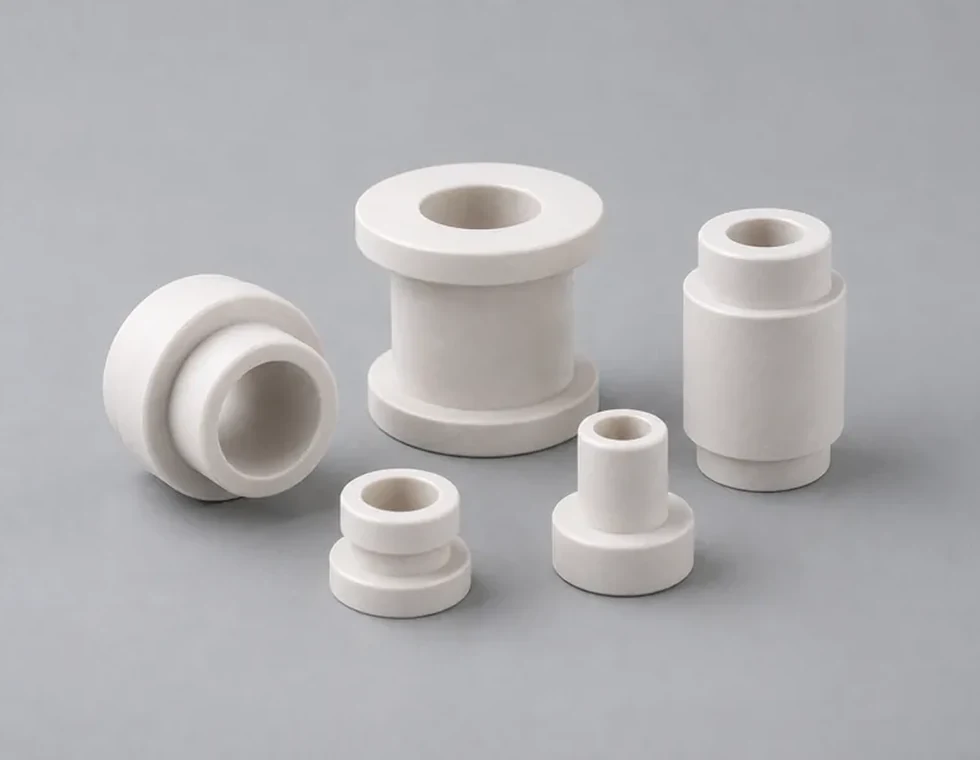
Product Item 01
Replace With Actual Product Name
Add one sentence explaining whether this bushing is designed for shaft support, wear, guiding, insulation or a special fit.
View Product →Custom ceramic bushings for shaft support, wear control, electrical isolation and precision mechanical assemblies. A bushing is not selected by dimensions alone—the load path, shaft fit, housing fit, motion type and service environment all influence material and finishing decisions.
The correct bushing design depends on whether the component carries radial load, guides motion, isolates electricity or protects a shaft from wear.
For bushings that support or locate shafts where wear resistance and stable geometry are important.
For reciprocating or guiding motion where surface finish, clearance and edge condition influence wear.
For bushings that separate conductive shafts, fasteners or housings while maintaining structural alignment.
For protecting metal housings or shafts from abrasion, corrosion or repeated contact.
Replace the sample cards with actual products. Keep each card focused on one clear mechanical or electrical use case.
Add one sentence explaining whether this bushing is designed for shaft support, wear, guiding, insulation or a special fit.
View Product →Add one sentence explaining whether this bushing is designed for shaft support, wear, guiding, insulation or a special fit.
View Product →Add one sentence explaining whether this bushing is designed for shaft support, wear, guiding, insulation or a special fit.
View Product →Add one sentence explaining whether this bushing is designed for shaft support, wear, guiding, insulation or a special fit.
View Product →Add one sentence explaining whether this bushing is designed for shaft support, wear, guiding, insulation or a special fit.
View Product →Add one sentence explaining whether this bushing is designed for shaft support, wear, guiding, insulation or a special fit.
View Product →Bushings combine contact stress, fit and motion. Material selection should therefore consider toughness and interface behavior in addition to hardness or temperature.
A practical option for wear resistance, electrical insulation and many general industrial bushing applications.
Useful where higher toughness, impact tolerance or thin-wall mechanical reliability is important.
Relevant for demanding mechanical, thermal-shock or higher-performance rotating applications.
Consider alternative materials when electrical, thermal or chemical requirements dominate the design.
For a ceramic bushing, the drawing should not be reviewed in isolation. The mating shaft, housing, fit condition and load direction help determine which surfaces need precision finishing and where stress may concentrate.
Ceramic bushings are sensitive to local stress and assembly conditions. The most useful engineering discussion often happens around interfaces rather than nominal dimensions.
If the shaft contacts only a small area of the bore, local stress and wear can rise quickly. Alignment, shaft geometry and support conditions should be reviewed together.
Excessive interference can create tensile or hoop stress in the ceramic. Fit strategy should account for wall thickness, housing material and service temperature.
Flanged bushings may see concentrated stress near shoulders, sharp transitions or clamped faces. Radii, support and load direction should be defined clearly.
Use application content to explain the mechanical role of the bushing, not just the industry name.
Bushings used to guide or support moving elements where wear, fluid exposure and dimensional stability are important.
Guide and support bushings used where fit, alignment and repeatable motion affect equipment performance.
Insulating bushings separating shafts, bolts, pins or housings from conductive structures.
Protective ceramic bushings used where metal wear or corrosion would shorten component life.
Precision bushings where roundness, clearance and surface condition influence shaft stability and wear.
Drawing-based bushings with flanges, steps, grooves or special fits developed for unique assemblies.
The most important dimensions are usually those that control shaft movement, housing fit and load alignment. Inspection should reflect the actual function of the bushing in the assembly.
A ceramic bushing can be dimensionally correct and still perform poorly if the shaft, housing, fit or load direction is not considered. Including mating-part information helps engineering evaluate the complete interface rather than only the ceramic component.
Yes, where the selected material, dimensions and machining route are technically feasible. Flange transitions and local stress areas should be reviewed carefully.
Clearance should be based on shaft size, motion type, temperature, mating material and expected load. The shaft drawing and operating conditions are helpful during engineering review.
Press-fit feasibility depends on ceramic material, bushing wall thickness, housing material, interference and service temperature. Excessive interference can create damaging stress.
Bore finish becomes important when the shaft slides or rotates against the ceramic surface, or when fit and wear behavior depend on the contact condition.
Provide the drawing, bushing dimensions, shaft and housing dimensions, fit requirement, material preference, load/motion conditions, service environment, prototype quantity and expected production volume.
Send your bushing drawing together with shaft, housing and fit information for engineering review.