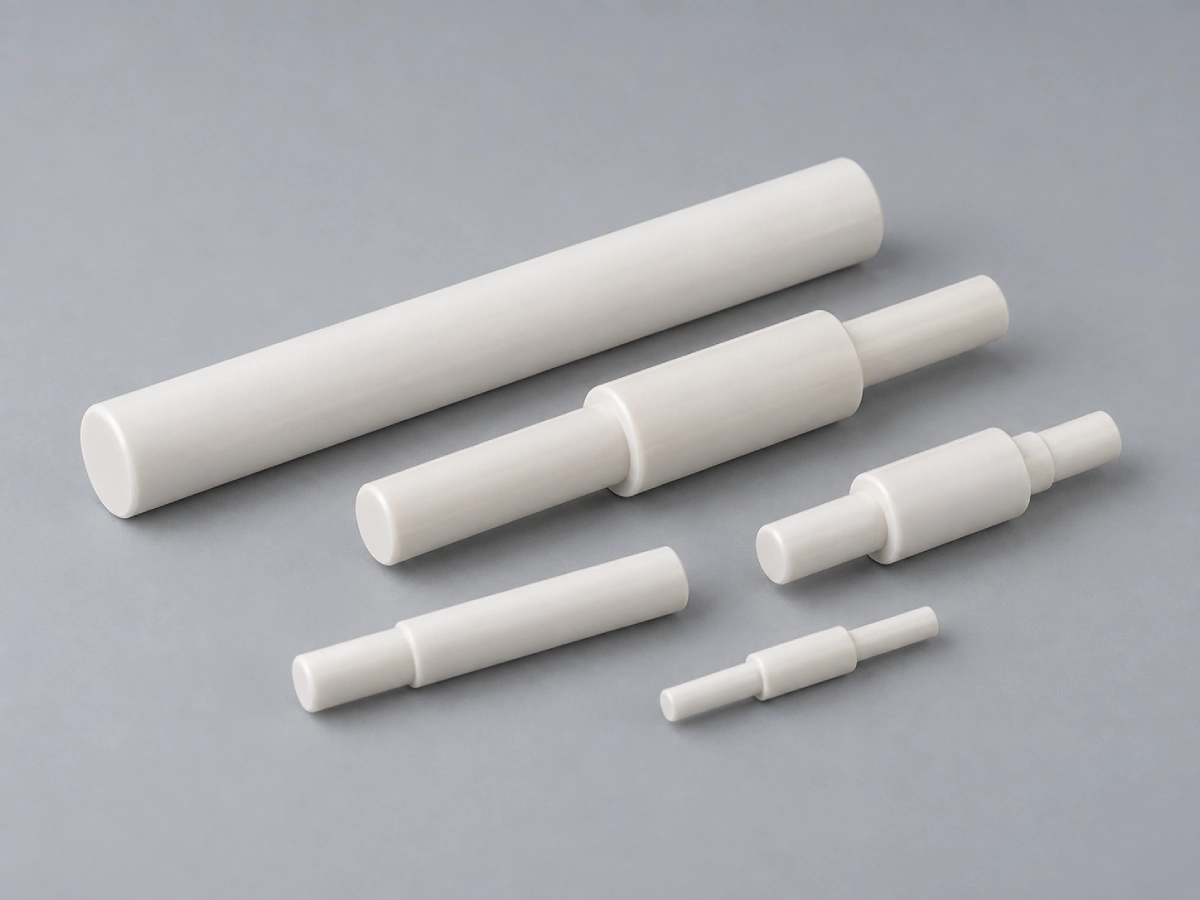
Product Item 01
Replace With Actual Product Name
Add one short sentence explaining whether this shaft is designed for rotation, guiding, fluid handling, insulation or a precision fit.
View Product →Custom ceramic shafts for rotating, guiding, pump, metering and electrically insulating assemblies. Shaft performance depends on more than diameter and length—straightness, runout, journal finish, shoulder geometry and the way torque or bending load enters the part all influence reliability.
A ceramic shaft used for slow guiding motion is not designed the same way as one transmitting torque or running through precision bearings. Start with the mechanical duty.
For assemblies where runout, journal diameter and surface condition influence rotational stability.
For shafts guiding sleeves, bearings or moving components where straightness and wear resistance are important.
For fluid-handling and metering assemblies where wear, corrosion resistance and dimensional stability matter.
For shaft-shaped structural elements that must provide electrical insulation between conductive components.
Replace these sample cards with actual shaft products. Keep each product description tied to its mechanical duty or interface requirement.
Add one short sentence explaining whether this shaft is designed for rotation, guiding, fluid handling, insulation or a precision fit.
View Product →Add one short sentence explaining whether this shaft is designed for rotation, guiding, fluid handling, insulation or a precision fit.
View Product →Add one short sentence explaining whether this shaft is designed for rotation, guiding, fluid handling, insulation or a precision fit.
View Product →Add one short sentence explaining whether this shaft is designed for rotation, guiding, fluid handling, insulation or a precision fit.
View Product →Add one short sentence explaining whether this shaft is designed for rotation, guiding, fluid handling, insulation or a precision fit.
View Product →Add one short sentence explaining whether this shaft is designed for rotation, guiding, fluid handling, insulation or a precision fit.
View Product →Shaft material should be selected around actual mechanical stress and mating conditions, not simply by choosing the highest hardness value.
A practical choice for wear resistance, electrical insulation and many moderate-load precision shaft applications.
Useful where higher toughness, smaller diameters or improved resistance to local mechanical damage are important.
Relevant for higher-performance rotating, thermal-shock or mechanically demanding shaft applications.
Consider alternative materials when electrical, chemical or thermal requirements dominate the design.
A shaft drawing should identify which diameters locate bearings, sleeves, seals or couplings. This helps engineering concentrate precision grinding where it affects function rather than applying the same tolerance everywhere.
Ceramic shafts can deliver excellent wear and stability, but their design should avoid stress concentrations and uncontrolled misalignment.
Long unsupported spans or side loads can create bending stress. Shaft diameter, support spacing and load direction should be evaluated together.
Sharp diameter transitions can concentrate stress. Fillets, chamfers and shoulder geometry should reflect the actual load path.
A shaft can meet diameter tolerance but still perform poorly if straightness or runout is not controlled where the assembly requires it.
Focus each application on the mechanical role of the shaft rather than listing industries without explaining why ceramic is used.
Wear- and corrosion-resistant shafts used in pumps, metering systems and fluid-handling assemblies.
Rotating or guiding shafts where dimensional stability, surface finish and wear resistance influence repeatability.
Precision ceramic shafts used where cleanliness, electrical insulation and dimensional stability are important.
Structural shaft components used to transmit position or support parts while maintaining electrical isolation.
Precision shafts used with sleeves, guides or seals where controlled fit and repeatable motion are required.
Drawing-based shafts with journals, shoulders, flats, grooves or coupling features for specialized equipment.
For ceramic shafts, diameter alone rarely tells the whole story. Inspection should focus on the journals, straightness, runout and surfaces that directly control motion or fit.
A useful shaft drawing identifies the surfaces that rotate, guide, seal, couple or support load. This allows engineering to define where precision grinding and tighter geometric control are truly required.
Yes, where the material, dimensions and geometry are suitable. Critical journals can be identified on the drawing so precision finishing is applied only where function requires it.
Straightness becomes important when the shaft rotates, runs through bearings or sleeves, or must maintain alignment over a longer unsupported length.
Custom features may be possible depending on material, feature size, transition geometry and manufacturing route. Stress concentration around shoulders and sharp features should be reviewed.
The selection depends on load, speed, shaft diameter, temperature, mating materials, electrical requirements and expected wear. Material should be chosen around the actual duty rather than hardness alone.
Provide the drawing, diameter, length, journal dimensions, geometric tolerances, surface requirements, load or speed information, service environment, prototype quantity and expected production volume.
Send your drawing and identify the critical journals, fit surfaces and operating loads for engineering review.