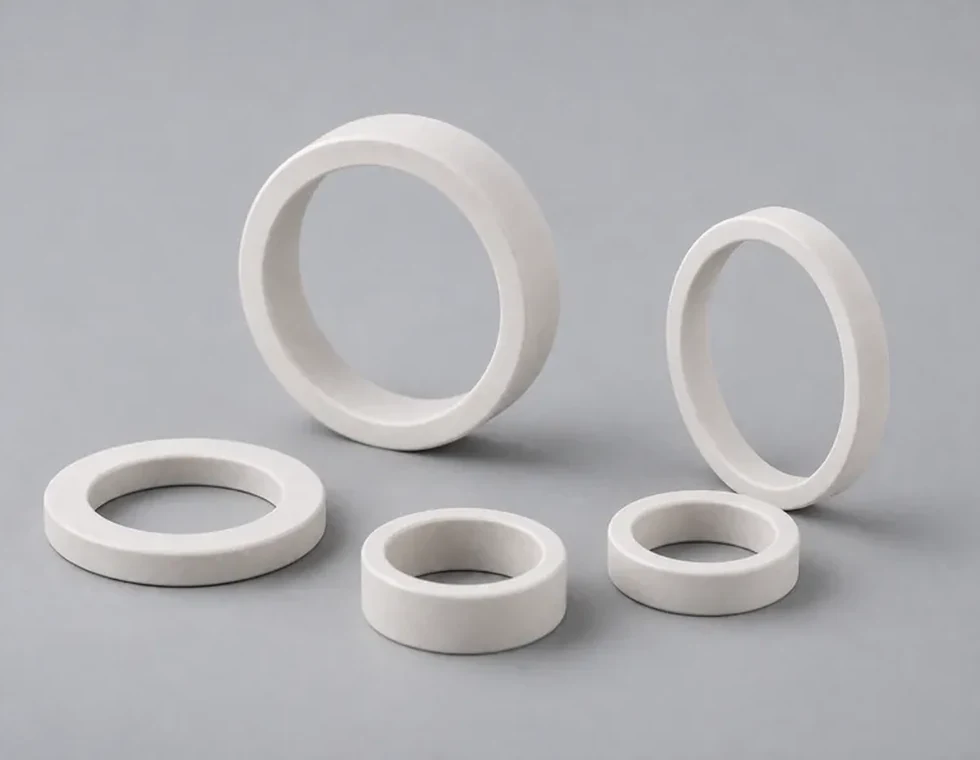
Alumina Ceramic
Alumina Ceramic Rings
A practical choice for electrical insulation, wear resistance and dimensional stability in general industrial assemblies.
Discuss Alumina Rings →Custom ceramic rings for insulating interfaces, wear control, sealing surfaces, bearing systems and precision assemblies. Ring performance depends not only on material, but also on OD/ID relationship, thickness, concentricity, flatness and the way the component is loaded in service.
Ceramic rings are often specified by what they separate, support, guide or seal. Define the interface first, then select material and finishing.
For insulating spacers, washers and ring-shaped barriers between conductive components.
For interfaces exposed to friction, repeated movement or abrasive contact.
For ring faces where flatness, surface finish and dimensional stability affect sealing behavior.
For precision ring components where roundness, concentricity and wear performance influence rotation.
Explore ceramic ring options for electrical insulation, wear control, sealing interfaces, rotating systems and custom precision assemblies.
A practical choice for electrical insulation, wear resistance and dimensional stability in general industrial assemblies.
Discuss Alumina Rings →Selected for compact precision components where fracture toughness, edge durability and fine surface quality are important.
Discuss Zirconia Rings →Suitable for demanding mechanical and thermal service where strength, thermal-shock resistance and low mass are valued.
Discuss Silicon Nitride Rings →Ring-shaped spacers and barriers engineered to isolate conductive parts while maintaining stable geometry under heat or load.
Discuss Insulating Rings →Designed for sliding, sealing and contact interfaces where wear resistance, flatness and surface condition influence service life.
Discuss Seal & Wear Rings →Drawing-based rings for non-standard OD, ID, thickness, grooves, chamfers, concentricity and functional surface requirements.
Discuss Custom Rings →Material selection should consider more than hardness or temperature rating. Contact stress, edge loading, chemical exposure, thermal conditions and finishing requirements all influence long-term ring performance.
Good starting point for electrical insulation, wear resistance and general industrial ring components.
Consider where higher toughness, edge durability or smaller precision rings are important.
Relevant for demanding mechanical, thermal-shock or rotating-system requirements.
Use application-specific materials when electrical, thermal or chemical requirements dominate the design.
Unlike a simple flat washer, a precision ceramic ring may depend on the relationship between several surfaces. Mark the functional faces and critical fits on the drawing before deciding which features need secondary finishing.
Review these three points early because they can directly affect fit, service life, sealing performance and prototype success.
Sharp edges, uneven clamping or unsupported contact can create local stress concentrations. Chamfer and support conditions should be reviewed together.
OD and ID may both be within size tolerance while the ring still performs poorly if concentricity is not controlled where the assembly requires it.
For sealing, mounting or stacked assemblies, face flatness and parallelism may matter more than a very tight non-functional diameter tolerance.
Ring-shaped ceramics appear in assemblies where insulation, wear, support, spacing, sealing or rotational precision are required.
Ring-shaped spacers and barriers used to isolate conductive parts while maintaining geometry under heat or load.
Components used at sliding or guiding interfaces where abrasion resistance and stable dimensions are important.
Precision rings used around sealing interfaces where flat contact surfaces and chemical compatibility matter.
Ring components where roundness, concentricity and wear performance influence rotating-system stability.
Insulating or structural ring components used around vacuum, sealing or ceramic-to-metal interfaces.
Drawing-based rings developed for unique diameters, grooves, interfaces, contact faces or inspection requirements.
Ring inspection should follow the way the component functions in the assembly. Critical characteristics may differ significantly between an insulating spacer, a wear ring and a sealing interface.
Identify the surfaces that locate, seal, guide, clamp or rotate directly on the drawing. This allows the manufacturing and inspection plan to focus on the dimensions that actually control assembly performance.
Yes, where the selected material, ring geometry, dimensions and finishing requirements are technically feasible. Functional surfaces and critical fits should be identified clearly.
Not necessarily. Precision finishing should be applied where the dimensions affect fit, sealing, rotation or assembly. Non-critical surfaces may be left in a more economical condition if the application allows it.
Concentricity becomes important when OD and ID work together to locate rotating parts, maintain wall consistency or control alignment in the final assembly.
Depending on material and geometry, secondary finishing can be evaluated for ring faces that require improved flatness, parallelism or surface condition.
Provide the drawing, OD, ID, thickness, critical tolerances, material preference, operating conditions, prototype quantity and expected production volume.
Send your drawing and identify the critical fit, contact or sealing surfaces for engineering review.