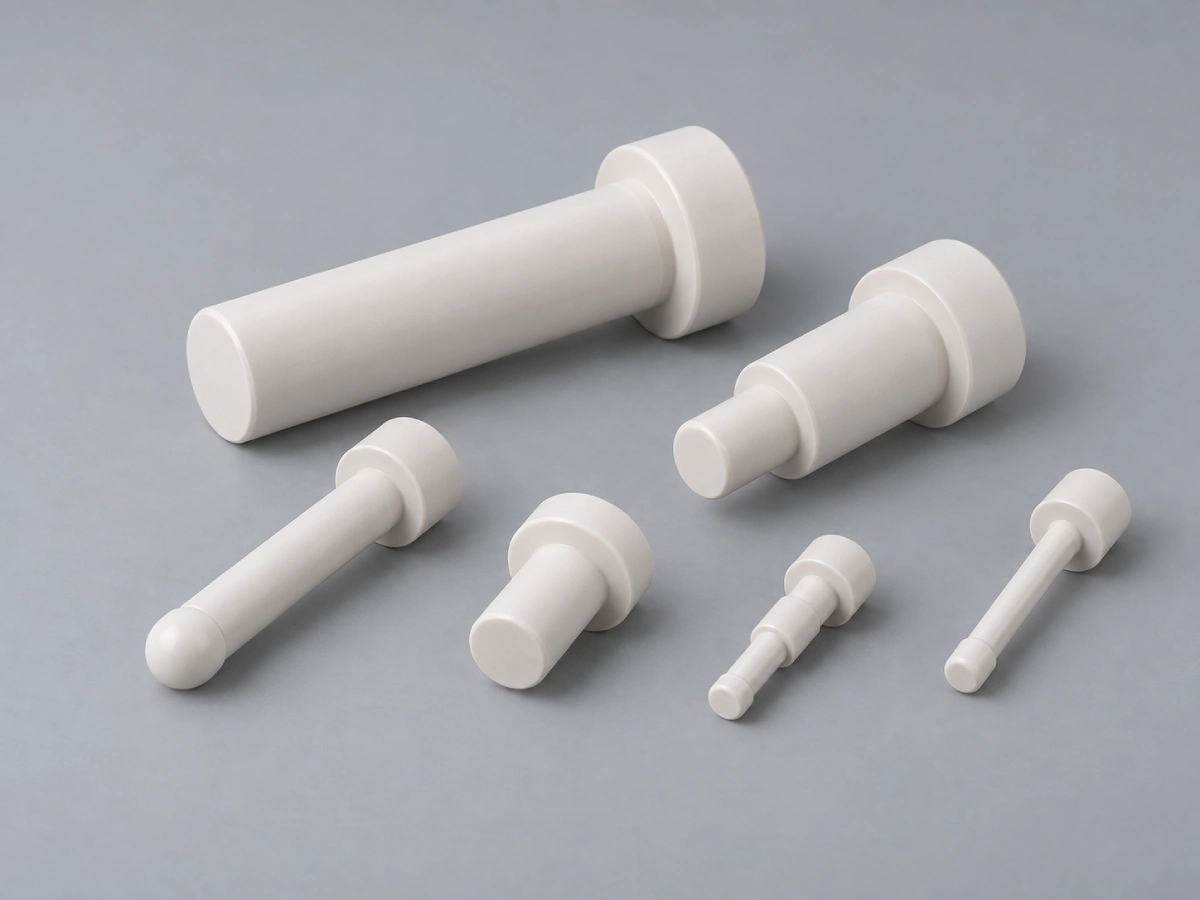
Product Item 01
Replace With Actual Product Name
Add one short sentence explaining whether this plunger is used for dosing, sealing, fluid handling, shutoff or linear actuation.
View Product →Custom ceramic plungers for metering, dosing, sealing and high-wear fluid-handling assemblies. Plunger performance depends on the relationship between the sealing land, tip geometry, stroke-related movement, mating sleeve or valve seat, and the actual medium passing through the system.
A ceramic plunger used in a dosing pump has a different engineering focus from one used at a sealing interface or shutoff point. Start with the operating duty, then define geometry and finish.
For plungers where dimensional consistency, low wear and repeatable motion affect flow accuracy and service life.
For components that contact a seat, sleeve or valve interface where tip geometry and sealing-surface condition matter.
For plunger systems exposed to slurries, chemicals or high-wear conditions where stable surfaces help extend lifetime.
For plungers guiding controlled linear motion where straightness, concentricity and mating-fit quality influence performance.
Replace the sample cards with actual plunger products. Each card should explain the working duty, medium or interface the plunger is designed for.
Add one short sentence explaining whether this plunger is used for dosing, sealing, fluid handling, shutoff or linear actuation.
View Product →Add one short sentence explaining whether this plunger is used for dosing, sealing, fluid handling, shutoff or linear actuation.
View Product →Add one short sentence explaining whether this plunger is used for dosing, sealing, fluid handling, shutoff or linear actuation.
View Product →Add one short sentence explaining whether this plunger is used for dosing, sealing, fluid handling, shutoff or linear actuation.
View Product →Add one short sentence explaining whether this plunger is used for dosing, sealing, fluid handling, shutoff or linear actuation.
View Product →Add one short sentence explaining whether this plunger is used for dosing, sealing, fluid handling, shutoff or linear actuation.
View Product →For plungers, the best material depends on what the component touches and how it moves. Surface interaction is often more important than a simple catalog hardness comparison.
A practical option for wear resistance, chemical stability and many general metering or sealing plunger applications.
Useful where higher toughness, impact tolerance or resistance to local edge damage is important.
Relevant for demanding mechanical conditions, thermal shock or applications requiring improved strength-to-weight performance.
Alternative ceramic systems may be considered when media compatibility, thermal behavior or electrical requirements dominate the design.
Not every section of a plunger needs the same tolerance or surface condition. Identify which area meters, seals, slides, actuates or contacts a seat so finishing can be concentrated where it matters.
Many plunger problems start at the contact or sealing area rather than in the nominal body dimension. These issues are worth reviewing before prototype release.
Sharp contact edges, impact loading or poor mating-seat alignment can chip the tip or reduce sealing consistency. Tip geometry should match the actual contact method.
If the plunger is guided poorly or loaded off-center, the sealing land or sliding area may wear unevenly. Guide quality and mating-part alignment should be checked together.
Some plunger systems rely on fluid lubrication. If lubrication is limited, the surface finish and mating-material selection become more critical to wear behavior.
Focus on the working role of the plunger in the assembly—metering, sealing, shutoff or high-wear contact—not just the industry label.
Precision plungers used where repeatable displacement, wear resistance and stable dimensions affect dosing accuracy.
Plunger components contacting seats or sealing interfaces where tip geometry and surface condition influence shutoff behavior.
Plungers used in systems where media compatibility and stable ceramic surfaces help extend service life.
Wear-resistant plungers developed for slurry, particulate or other high-wear operating environments.
Small or highly controlled plungers used where linear motion, fit and repeatability affect output consistency.
Drawing-based plungers with special noses, shoulders, grooves or end features for specific OEM assemblies.
For ceramic plungers, the most important characteristics are usually the ones that control sealing, guidance or movement. Inspection should follow the actual plunger duty rather than treating all surfaces as equally critical.
A useful plunger drawing identifies which zones seal, slide, meter or contact a seat. That allows engineering to determine where grinding, polishing or tighter geometric control is functionally necessary.
Yes, where the selected material, geometry, feature transitions and functional surfaces are technically feasible. Drawings should identify the sealing, guiding and contact areas clearly.
In many cases, yes. Functional finishing can be concentrated on the sealing or sliding areas rather than applying the same surface requirement to the entire part.
Mating-part dimensions, fit relationship, seat or guide geometry, media type, surface requirements and the expected motion or stroke all help engineering review the application properly.
The answer depends on the media, wear pattern, contact stress, impact risk, temperature and mating interface. The most suitable ceramic should be selected around the working conditions, not from a generic material ranking alone.
Provide the drawing, diameter, length, sealing or tip details, mating-part information, surface requirements, media and operating conditions, prototype quantity and expected production volume.
Send your drawing and identify the sealing, guiding and contact zones for engineering review.