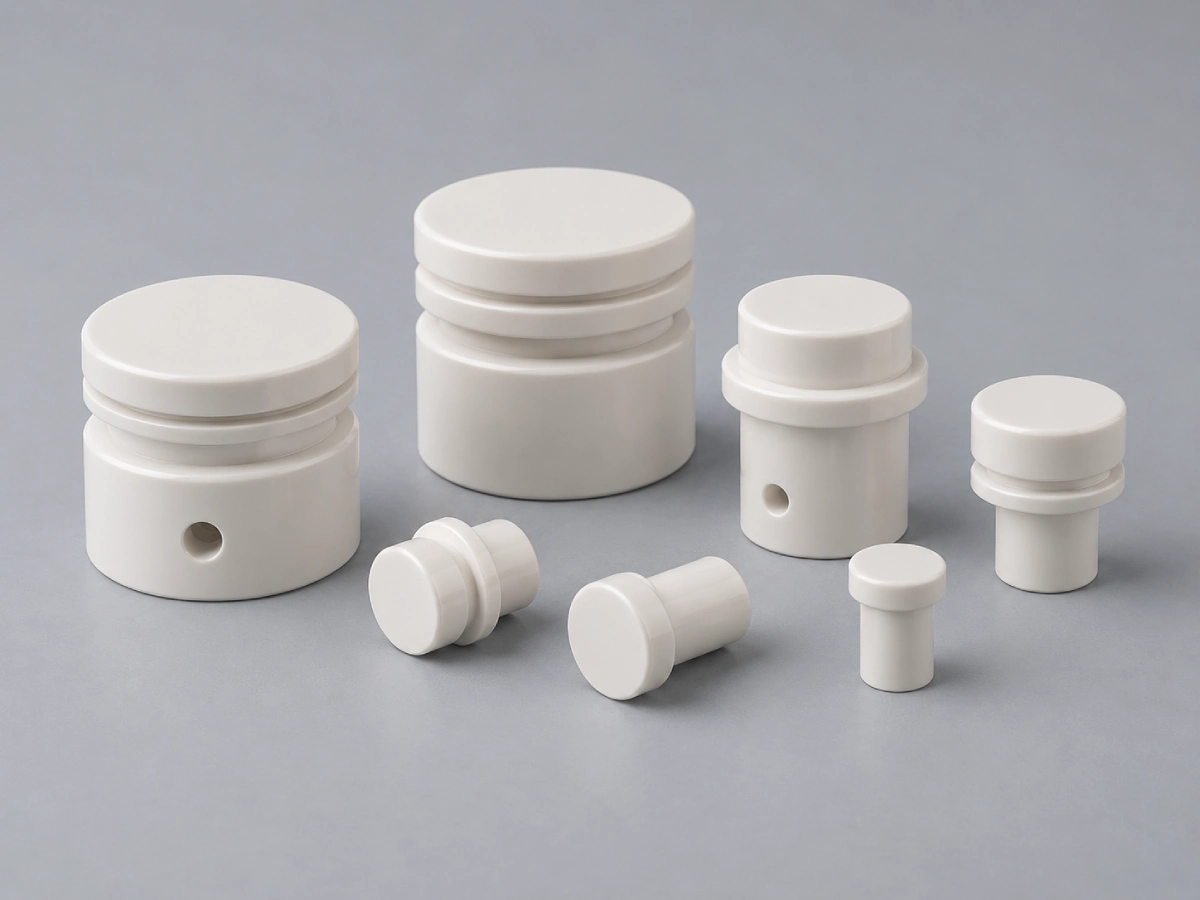
Product Item 01
Replace With Actual Product Name
Add one sentence explaining whether this piston is designed for pumping, pressure transfer, guided reciprocation or harsh-media service.
View Product →Custom ceramic pistons for reciprocating pumps, dosing equipment, pressure-transfer assemblies and demanding fluid-handling systems. Piston design is driven by the cylinder interface, pressure-loaded face, guiding surfaces and clearance strategy—not simply by copying a plunger geometry.
A piston works as part of a cylinder system. Before choosing material or tolerance, define pressure direction, bore fit, stroke, guidance and the fluid or gas environment.
For pistons where pressure acts on an end face and force is transferred through a reciprocating component.
For pump pistons where cylinder fit, stroke and wear stability influence displacement and service life.
For pistons moving repeatedly inside a bore where straightness, skirt guidance and clearance control motion quality.
For systems exposed to abrasive or chemically aggressive media where conventional piston materials may wear rapidly.
Replace the sample cards with actual products. Each card should explain the cylinder, pressure or reciprocating duty the piston is designed to handle.
Add one sentence explaining whether this piston is designed for pumping, pressure transfer, guided reciprocation or harsh-media service.
View Product →Add one sentence explaining whether this piston is designed for pumping, pressure transfer, guided reciprocation or harsh-media service.
View Product →Add one sentence explaining whether this piston is designed for pumping, pressure transfer, guided reciprocation or harsh-media service.
View Product →Add one sentence explaining whether this piston is designed for pumping, pressure transfer, guided reciprocation or harsh-media service.
View Product →Add one sentence explaining whether this piston is designed for pumping, pressure transfer, guided reciprocation or harsh-media service.
View Product →Add one sentence explaining whether this piston is designed for pumping, pressure transfer, guided reciprocation or harsh-media service.
View Product →The terms are sometimes used differently across industries, but the mechanical role helps keep the website categories clear and prevents two pages from saying the same thing.
Typically works inside a cylinder or bore, with pressure acting on a face and guidance or clearance around the piston body playing a major role in performance.
Typically moves through a fixed guide or sealing interface, with a long precision surface, sealing land or tip geometry often dominating the design.
Terminology varies by equipment design. Classify the component by its actual mechanical function and customer search intent rather than the name alone.
Piston material should be selected around cylinder interaction, pressure cycle, side load and media compatibility—not only wear resistance.
A practical option for wear resistance, chemical stability and many industrial piston applications with controlled loading.
Useful where higher toughness, impact tolerance or resistance to local mechanical damage is important.
Relevant for more demanding mechanical, thermal-shock or high-cycle applications where strength and low density may be beneficial.
Alternative materials may be considered where chemical, electrical or thermal requirements dominate the design.
A piston should be reviewed as part of the piston–cylinder system. Mark the pressure-loaded face, guiding diameter, clearances and any sealing or connection features so engineering can focus tolerances where they affect function.
Ceramic pistons are especially sensitive to cylinder alignment, local contact and rapid pressure or temperature changes. These risks should be reviewed with the mating bore.
Clearance that is too small can increase contact, friction or seizure risk when thermal expansion, debris or alignment changes occur during operation.
Off-axis loading can concentrate contact on one side of the piston, creating uneven wear or local stress. Cylinder alignment and guide conditions should be reviewed together.
Sharp transitions, local support conditions or pressure spikes may concentrate stress around the piston face or feature transitions. Geometry should reflect the real pressure cycle.
Keep the emphasis on pressure and reciprocating function so this page remains clearly different from the Ceramic Plungers category.
Ceramic pistons used inside pump cylinders where wear stability, pressure transfer and repeatable reciprocation are important.
Piston components for pressure-transfer assemblies where dimensional stability and media compatibility affect service life.
Precision pistons used in controlled-displacement systems where bore fit and stroke repeatability affect output.
Ceramic pistons used where corrosive media can accelerate wear or attack conventional metallic components.
Custom piston components used in specialized reciprocating mechanisms requiring electrical, thermal or wear advantages.
Drawing-based pistons developed around specific bore diameters, pressure faces, grooves, guides and operating cycles.
For ceramic pistons, inspection should prioritize the diameters, surfaces and geometric relationships that control running clearance, alignment and pressure transfer.
A piston drawing is only part of the system. Bore diameter, desired running clearance, pressure range, stroke and media help engineering evaluate the component as it will actually operate.
Terminology varies, but a piston typically operates inside a cylinder or bore and transfers pressure across a face, while a plunger typically moves through a stationary guide or sealing interface. The actual mechanical function should determine how the part is specified.
Clearance should consider cylinder size, alignment, media, operating temperature, pressure, surface finish and cycle conditions. The cylinder or bore information should be provided together with the piston drawing.
Custom grooves, steps, faces or connection features may be possible depending on material, feature geometry and manufacturing route. Sharp transitions should be reviewed for local stress.
The correct material depends on pressure, side load, impact risk, media compatibility, temperature, wear conditions and mating-cylinder design. There is no single material that is best for every piston application.
Provide the piston drawing, cylinder dimensions, running clearance, pressure and stroke information, media, temperature, surface requirements, prototype quantity and expected production volume.
Send the piston drawing together with cylinder, pressure, clearance and operating-condition information for engineering review.