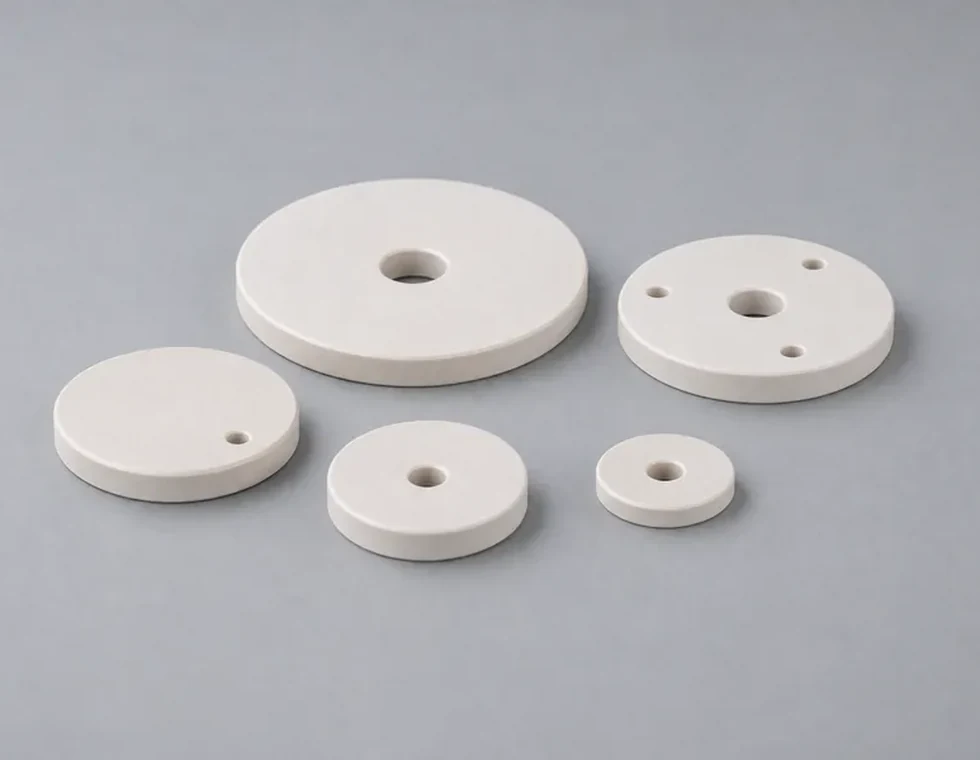
Product Item 01
Replace With Actual Product Name
Add one short sentence explaining whether this disc is selected for insulation, wear, sealing, spacing or a precision working face.
View Product →Custom ceramic discs for insulation, wear surfaces, valve interfaces, precision spacers and flat working faces. Disc performance depends on diameter, thickness, flatness, parallelism and surface condition—not simply on the material grade.
Ceramic discs are often selected for the behavior of their two broad faces. Identify the functional surface first, then define material, thickness and finishing.
For circular insulating barriers, spacers and mounting interfaces that separate conductive components.
For flat working faces exposed to abrasion, rubbing or repeated contact.
For disc-shaped components where a flat face, edge or local opening influences flow or sealing behavior.
For circular structural components where thickness, flatness and parallelism control assembly position.
Replace the sample cards with actual disc products. Each card should state one real function, material or engineering advantage.
Add one short sentence explaining whether this disc is selected for insulation, wear, sealing, spacing or a precision working face.
View Product →Add one short sentence explaining whether this disc is selected for insulation, wear, sealing, spacing or a precision working face.
View Product →Add one short sentence explaining whether this disc is selected for insulation, wear, sealing, spacing or a precision working face.
View Product →Add one short sentence explaining whether this disc is selected for insulation, wear, sealing, spacing or a precision working face.
View Product →Add one short sentence explaining whether this disc is selected for insulation, wear, sealing, spacing or a precision working face.
View Product →Add one short sentence explaining whether this disc is selected for insulation, wear, sealing, spacing or a precision working face.
View Product →Circular ceramic parts are easy to classify incorrectly. The category should follow the dominant geometry and purchasing intent so buyers can reach the right page without duplicate product structures.
Use when the part is primarily a solid or near-solid circular plate and the broad faces are functionally important.
Use when the central opening is a major functional feature and OD/ID relationship or concentricity controls performance.
Use when the component primarily functions as a thin insulating or spacing element around a fastener or shaft.
Use when the dominant purchasing intent is a flat non-circular plate or panel rather than a circular disc.
If only one face controls sealing, spacing, wear or mounting, mark it clearly. This helps avoid unnecessary finishing on non-critical surfaces while protecting the characteristics that matter.
Disc applications are often surface-driven. The correct route depends on how the face is loaded, whether it needs electrical insulation and whether surface finish controls performance.
Uniform compression, local point loading, sliding contact and edge clamping create very different stress conditions and should be reviewed before finalizing thickness.
As-fired, ground, lapped or polished surfaces should be selected according to insulation, sealing, wear, motion or mounting requirements.
Unsupported spans, hard clamps and sharp contact edges can increase fracture risk even when the material itself is suitable for the environment.
Focus on the job performed by the circular working face rather than listing industries without context.
Circular insulating barriers and mounting components used where dielectric performance and dimensional stability are required.
Flat ceramic working surfaces used where abrasion resistance and surface stability are important.
Disc-shaped ceramic components used where flatness, surface condition or local openings influence fluid-control assemblies.
Circular spacing components where thickness tolerance, flatness and parallelism control assembly position.
Disc-shaped supports or barriers used in equipment where thermal stability and electrical insulation may be required together.
Drawing-based discs with holes, grooves, pockets, edge features or specific working-face requirements.
For many ceramic discs, thickness, flatness, parallelism and functional surface condition have greater impact on performance than cosmetic perfection on every non-critical feature.
A disc drawing becomes much easier to evaluate when the functional face, mounting condition and contact area are identified. This helps engineering choose the right forming, grinding, lapping or polishing route.
A ceramic disc is primarily a solid or near-solid circular component. If a central opening becomes a dominant functional feature and OD/ID relationship is critical, the part may be better treated as a ceramic ring.
Depending on material, size and geometry, secondary surface finishing can be evaluated when flatness, parallelism or surface condition is functionally important.
Custom features may be possible depending on material, feature size, location and manufacturing route. A drawing review is recommended before quotation.
The selection depends on electrical requirements, wear, contact stress, temperature, chemical exposure and surface-finish needs. The final choice should be based on the actual operating conditions rather than hardness alone.
Provide the drawing, diameter, thickness, flatness or parallelism requirements, material preference, surface requirements, operating conditions, prototype quantity and expected production volume.
Send your drawing and identify the functional face, thickness and critical surface requirements for engineering review.