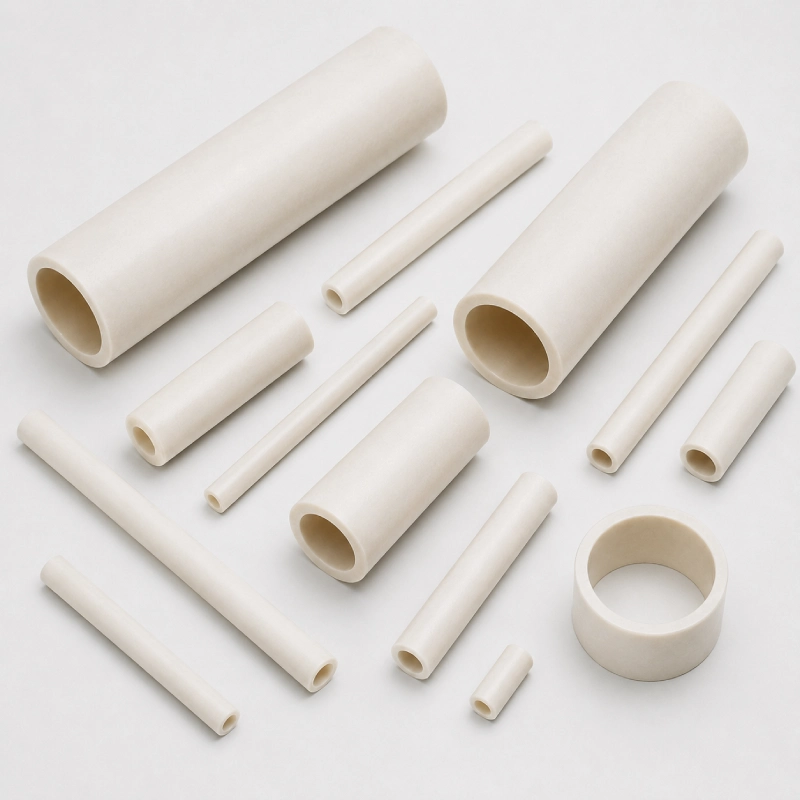
Alumina Ceramic
Alumina Ceramic Tubes
A practical choice for electrical insulation, wear resistance and stable performance in general industrial assemblies.
Discuss Your Requirement →Custom ceramic tubes manufactured for insulation, wear resistance, high-temperature service and precision industrial assemblies. Select the material, geometry and finishing route according to your operating conditions and drawing requirements.
Start with the condition that matters most to your design. Material, dimensions and finishing can then be matched to the actual service environment.
For components that must isolate current while maintaining dimensional stability.
For guides, sleeves and protective tube components exposed to friction or abrasion.
For furnace, heating and thermal-process environments where conventional materials may be unsuitable.
For components where OD, ID, length, concentricity or surface condition affect assembly performance.
Select ceramic tubes by material, finishing route and functional requirement for industrial equipment, electrical insulation, wear service and custom assemblies.
A practical choice for electrical insulation, wear resistance and stable performance in general industrial assemblies.
Discuss Your Requirement →Suitable for compact components where higher fracture toughness, wear resistance and surface quality are important.
Discuss Your Requirement →Designed for demanding service where high-temperature strength, thermal-shock resistance and mechanical reliability matter.
Discuss Your Requirement →Ground OD, ID and end faces can support controlled fit, concentricity and surface requirements in precision assemblies.
Discuss Your Requirement →Tube-shaped ceramic insulation for electrical, heating and equipment-protection applications requiring thermal stability.
Discuss Your Requirement →Drawing-based ceramic tubes can be developed with custom dimensions, holes, slots, flats, chamfers and end features.
Discuss Your Requirement →Material choice should follow the operating temperature, electrical load, mechanical stress, wear level and chemical environment of the application.
| Material | Typical Selection Reason | Consider When | Typical Fit |
|---|---|---|---|
| Alumina Ceramic | Electrical insulation, wear resistance and cost-performance balance. | General industrial tube applications require stable insulation or wear performance. | General industrial insulation and wear service |
| Zirconia Ceramic | High fracture toughness and good surface quality. | Mechanical toughness or smaller precision components are important. | Toughness-critical precision components |
| Silicon Nitride Ceramic | High-temperature strength and thermal-shock resistance. | The component faces repeated thermal cycling or demanding mechanical service. | Thermal cycling and high-temperature service |
| Other Advanced Ceramics | Application-specific electrical, thermal or chemical requirements. | Standard material choices do not meet the operating conditions. | Application-specific engineering review |
Final material selection should be based on actual operating temperature, electrical requirements, mechanical load, chemical exposure and manufacturing feasibility.
A clear drawing helps separate economical as-fired dimensions from features that require grinding, polishing or additional inspection.
Tolerance capability depends on ceramic material, tube dimensions, wall thickness, feature location and the selected finishing route.
Critical OD, ID, length and fit dimensions should be identified on the drawing so the correct manufacturing route can be selected.
Straightness, concentricity, roundness and end-face requirements can affect assembly and should be specified only where functionally necessary.
As-fired, ground, polished or other finished surfaces can be evaluated according to sealing, wear, motion or assembly requirements.
Ceramic tubes are commonly selected where electrical insulation, thermal stability, wear resistance or dimensional control directly affects equipment performance.
Tube-shaped insulating components for assemblies where dielectric performance and thermal stability are required.
Protective, structural or insulating tube components used in heating and thermal-processing environments.
Precision ceramic tubes where dimensional control, cleanliness and material stability matter.
Ceramic tube components used where insulation, sealing interfaces or low-contamination materials are needed.
Guide, sleeve or protective tube functions where wear resistance and dimensional stability are important.
Drawing-based tube components developed around specific dimensions, interfaces and operating conditions.
For custom ceramic tubes, the fastest way to evaluate manufacturability is to provide the component drawing together with the intended operating environment.
The inspection plan should focus on the dimensions and characteristics that affect assembly or service performance rather than treating every feature as equally critical.
These practical checkpoints help engineering and purchasing teams define the right material, geometry, finishing route and inspection requirements before quotation.
Compare temperature, insulation, wear, toughness and thermal-shock requirements before locking in the ceramic material.
Identify functional dimensions first, then specify only the tolerances and surface conditions that matter to assembly performance.
For non-standard geometry, provide a drawing so manufacturability, finishing and inspection requirements can be reviewed together.
Common options include alumina, zirconia and silicon nitride, with other advanced ceramic materials evaluated according to operating conditions and manufacturing feasibility.
Yes, where the requested geometry, dimensions, material and finishing route are technically feasible. A drawing review is recommended before quotation.
Tolerance capability depends on material, dimensions, wall thickness, feature location and whether secondary grinding or other finishing is required. Critical dimensions should be identified on the drawing for engineering review.
Prototype feasibility and quantity should be confirmed according to the manufacturing route, tooling requirements and geometry of the ceramic tube.
Provide the drawing, material preference, critical dimensions and tolerances, operating conditions, prototype quantity and expected production volume.
Send your drawing and operating requirements for material, manufacturability and inspection review.