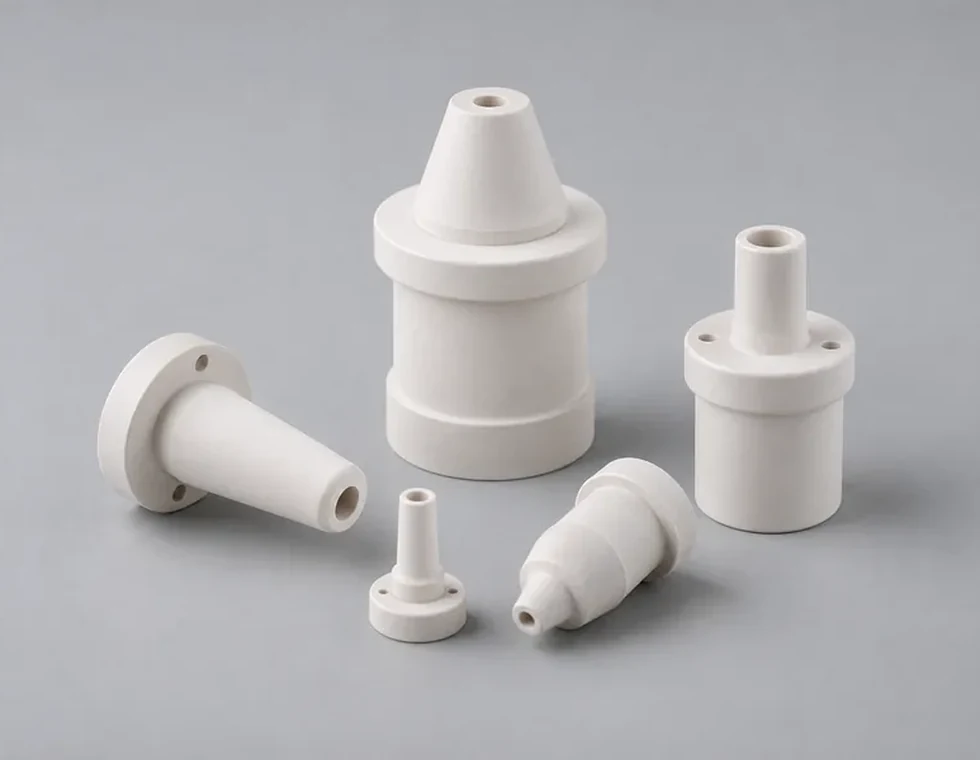
Precision Flow Nozzle
Precision Jetting Ceramic Nozzle
Designed for controlled, concentrated flow where orifice accuracy and outlet geometry influence jet stability and repeatability.
View Product →Custom ceramic nozzles for jetting, spraying, atomization, abrasive media and precision flow-control applications. Nozzle performance depends on the orifice, bore profile, outlet geometry, sealing interface and the actual medium moving through the part—not just the outside shape.
A ceramic nozzle for abrasive blasting is selected very differently from one used for atomization or a focused fluid jet. Start with the flow task, then define geometry and material.
For nozzles that need a controlled, concentrated stream where orifice shape and bore profile influence accuracy and velocity.
For applications where droplet formation, spray angle or distribution depends on outlet geometry and fluid condition.
For media that rapidly wear conventional nozzles and require a hard, stable internal flow path.
For systems where repeatable discharge, dosing or passage control depends on dimensional consistency of the nozzle passage.
UNIPRETEC supplies ceramic nozzle solutions for precision flow, spray control, abrasive service and custom OEM equipment, with geometry and material selected around the actual operating conditions.
Designed for controlled, concentrated flow where orifice accuracy and outlet geometry influence jet stability and repeatability.
View Product →Built for particle-laden or abrasive media where internal passage wear can change flow rate and service life.
View Product →Developed for spray and atomization duties where outlet profile, fluid condition and material stability affect spray behavior.
View Product →Suitable for dispensing and metering systems requiring consistent passage geometry and repeatable discharge performance.
View Product →Used in corrosive or high-purity process environments where stable ceramic surfaces help maintain reliable flow characteristics.
View Product →Manufactured to drawing with custom bores, seats, grooves, inlet transitions and outlet geometries for specialized OEM equipment.
View Product →Two nozzles with the same outer body can behave very differently if the orifice, inlet transition or outlet geometry changes. That is why nozzle engineering should start from the internal flow path.
Directly affects discharge rate, velocity and the balance between precision and clogging resistance.
Straight, tapered, converging or shaped passages influence pressure loss, stream quality and wear pattern.
The exit shape can influence jet stability, spray distribution or flow separation.
The way the nozzle locates and seals in the assembly affects repeatability and leakage risk.
A useful nozzle drawing identifies which features control the fluid path, which surfaces seal, and which connections locate the part. This helps engineering focus tolerances where they truly affect performance.
Nozzle material should be selected according to the actual fluid, particle content, pressure and thermal behavior of the system—not simply by maximum hardness.
A practical option for many wear-resistant and chemically stable nozzle applications with well-controlled conditions.
Useful where higher toughness, impact tolerance or resistance to local damage around the orifice is important.
Relevant for demanding mechanical or thermal-shock environments where strength and thermal behavior are critical.
Alternative ceramic materials may be selected when corrosion resistance, electrical properties or thermal conditions drive the design.
Ceramic nozzles often fail functionally before they fail visibly. Flow instability, wear drift and clogging can all originate from small geometric or system-level issues.
If abrasive media enlarges the orifice over time, the discharge pattern and flow rate can drift beyond acceptable process limits. Wear life should be considered from the start.
Very small passages may offer high precision but can become more sensitive to particles, crystallization or residue build-up. Process cleanliness matters as much as nominal size.
If the nozzle does not locate or seal correctly, the stream or spray pattern can shift even when the nozzle itself is dimensionally correct. Interface design should be checked with the housing.
Ceramic nozzles are used where flow stability, wear resistance, chemical compatibility and dimensional consistency directly affect equipment performance.
Wear-resistant nozzles used where particle-laden media would rapidly erode conventional materials.
Ceramic nozzles used where spray quality, droplet control and chemical resistance matter.
Nozzles designed for concentrated streams where exit geometry and orifice consistency influence accuracy.
Components used in systems where repeatable flow and stable passage geometry affect dosing performance.
Ceramic nozzles used in corrosive or high-purity environments where material stability is important.
Drawing-based nozzles with special bores, seats, grooves or outlet shapes for specialized equipment.
For ceramic nozzles, external dimensions matter, but the most critical inspection points are often inside the flow path. Inspection should reflect the actual performance-driving geometry.
A nozzle drawing is much more useful when it is supported by process information. The medium, pressure, desired discharge pattern and wear condition help engineering judge the correct geometry and material route.
Yes, where the selected material, orifice size, internal geometry and mounting features are technically feasible. The drawing should clearly identify the flow-critical features and sealing interfaces.
The medium, pressure, target flow behavior, wear condition, temperature and how the nozzle seals or locates in the assembly are all highly useful for engineering review.
The best material depends on the medium, pressure, particle content, wear pattern, thermal conditions and impact risk around the orifice. There is no single best ceramic for every nozzle application.
Yes, ceramic nozzles are often selected for abrasive conditions because of their wear resistance. The expected media type, velocity and service-life target should still be reviewed carefully.
Provide the drawing, orifice size, medium type, pressure or flow data, desired discharge behavior, temperature, sealing or mounting method, prototype quantity and expected production volume.
Send your drawing together with media, pressure and flow-behavior information for engineering review.