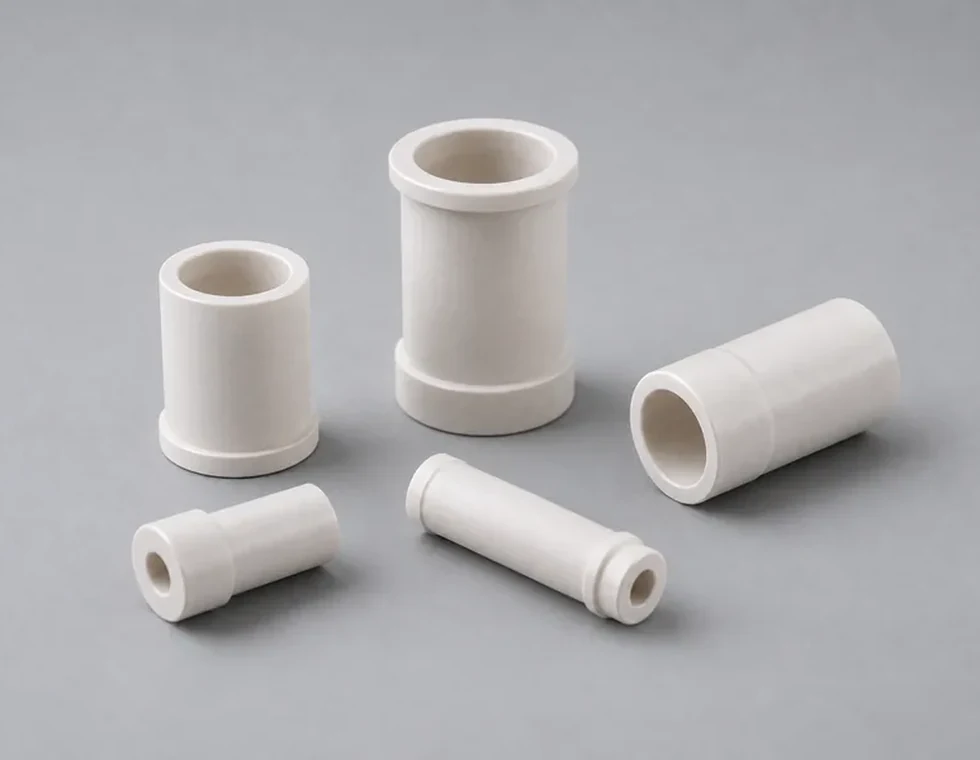
Product Item 01
Replace With Actual Product Name
Add one short sentence explaining whether this sleeve is selected for wear, insulation, shaft protection or precision fit.
View Product →Custom ceramic sleeves for shaft protection, wear interfaces, electrical insulation and precision equipment assemblies. Sleeve performance depends heavily on fit, wall thickness, surface finish and the relationship between the ceramic sleeve and the mating shaft or housing.
Ceramic sleeves may look simple, but their job in the assembly can be very different. Start with the contact condition, then define material and tolerance.
For sleeves that isolate a metal shaft from abrasive, corrosive or high-temperature contact.
For sliding, rotating or guiding interfaces where the ceramic surface controls wear performance.
For assemblies where a sleeve-shaped component separates conductive parts or protects electrical interfaces.
For components where the relationship between ID, OD, length and concentricity controls assembly performance.
Replace the sample cards with your actual sleeve products. Each card should explain one clear application or buying reason.
Add one short sentence explaining whether this sleeve is selected for wear, insulation, shaft protection or precision fit.
View Product →Add one short sentence explaining whether this sleeve is selected for wear, insulation, shaft protection or precision fit.
View Product →Add one short sentence explaining whether this sleeve is selected for wear, insulation, shaft protection or precision fit.
View Product →Add one short sentence explaining whether this sleeve is selected for wear, insulation, shaft protection or precision fit.
View Product →Add one short sentence explaining whether this sleeve is selected for wear, insulation, shaft protection or precision fit.
View Product →Add one short sentence explaining whether this sleeve is selected for wear, insulation, shaft protection or precision fit.
View Product →For sleeves, the best material is often determined by the contact condition and mating part rather than by temperature rating alone.
A common starting point for wear resistance, electrical insulation and general industrial sleeve applications.
Useful when higher toughness, edge durability or thin-wall mechanical reliability is important.
Relevant for demanding mechanical, thermal-shock or rotating-system environments.
Consider alternative materials when thermal, electrical or chemical requirements dominate the design.
The same OD, ID and length can behave very differently depending on whether the sleeve is bonded, pressed, free-running, sliding or used as an electrical barrier. Mark the actual fit condition on the drawing.
These three issues are especially important for ceramic sleeves because assembly method and mating parts directly influence local stress.
Excessive interference can create damaging hoop stress. Press-fit requirements should be reviewed together with wall thickness and material toughness.
A ceramic sleeve and metal shaft or housing may expand differently during temperature changes. Assembly conditions should reflect the actual service temperature.
Thin walls and sharp edges can increase handling and assembly risk. Chamfers, radii and local support should be considered where appropriate.
Use the application section to show what the sleeve protects, isolates or guides inside the equipment.
Wear-resistant sleeve interfaces used around plungers, shafts or fluid-handling components.
Ceramic sleeves used at guiding or wear interfaces where dimensional stability and corrosion resistance matter.
Protective sleeves isolating metal shafts from abrasion, heat or aggressive service environments.
Insulating sleeves used around conductive shafts, pins, terminals or structural interfaces.
Guide and bearing-related sleeves where fit, concentricity and surface condition influence motion.
Drawing-based sleeve components developed around unique interfaces, clearances and operating conditions.
For ceramic sleeves, the most important inspection characteristics are usually the dimensions and surfaces that mate with the shaft, housing or moving component.
A sleeve drawing is more useful when it shows the mating diameter, fit condition, direction of load and service temperature. This helps engineering judge whether the design should be as-fired, ground, bonded, pressed or otherwise finished.
Yes, where the material, wall thickness, dimensions and finishing route are technically feasible. The mating-part dimensions and fit condition should be supplied for engineering review.
Only when the internal diameter directly controls fit, motion, wear or assembly. Grinding non-critical surfaces may add cost without improving function.
Press-fit feasibility depends on ceramic material, wall thickness, interference, housing material and service temperature. Excessive interference can create damaging stress and should be evaluated carefully.
The required finish depends on mating material, speed, load, lubrication and wear target. Functional surfaces should be identified before selecting a finishing process.
Provide the drawing, OD, ID, length, wall thickness, fit requirement, material preference, service environment, prototype quantity and expected production volume.
Send your drawing together with the mating-part dimensions and fit requirements for engineering review.