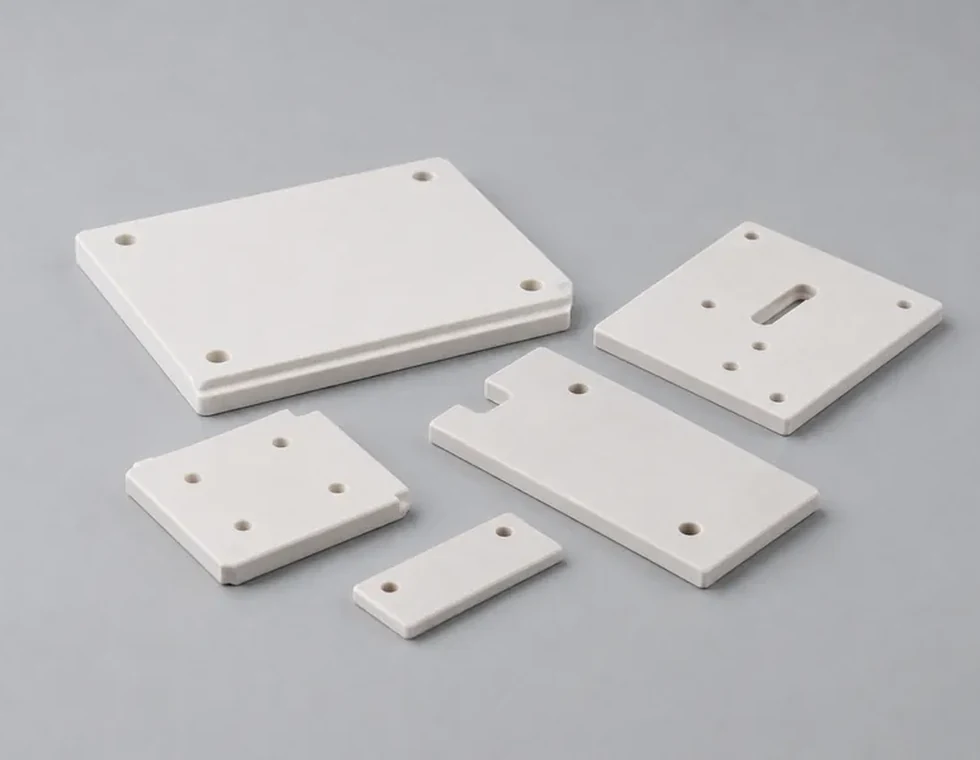
Product Item 01
Replace With Actual Product Name
Add one short sentence explaining the main application or purchasing reason.
View Product →Custom ceramic plates manufactured for electrical insulation, wear surfaces, high-temperature service and precision structural assemblies. Select the material, dimensions, flatness and finishing route according to your operating conditions and drawing requirements.
Start with the condition that matters most to your design. Material, dimensions and finishing can then be matched to the actual service environment.
For insulating plates, spacers and structural components that must isolate current while maintaining dimensional stability.
For wear plates, guides and sliding surfaces exposed to friction, abrasion or repeated contact.
For furnace, heating and thermal-process assemblies where plate geometry must remain stable at elevated temperatures.
For components where thickness, flatness, parallelism, hole position or surface finish affect assembly performance.
Replace the sample cards below with the actual ceramic plate products available on your website.
Add one short sentence explaining the main application or purchasing reason.
View Product →Add one short sentence explaining the main application or purchasing reason.
View Product →Add one short sentence explaining the main application or purchasing reason.
View Product →Add one short sentence explaining the main application or purchasing reason.
View Product →Add one short sentence explaining the main application or purchasing reason.
View Product →Add one short sentence explaining the main application or purchasing reason.
View Product →The category page should guide buyers toward the right material family without repeating the full material-page content.
| Material | Typical Selection Reason | Consider When | Next Step |
|---|---|---|---|
| Alumina Ceramic | Electrical insulation, wear resistance and cost-performance balance. | General industrial plate applications require stable insulation, wear resistance or dimensional stability. | Link to Alumina Material Page |
| Zirconia Ceramic | High fracture toughness and good surface quality. | Higher toughness, edge durability or smaller precision plate components are important. | Link to Zirconia Material Page |
| Silicon Nitride Ceramic | High-temperature strength and thermal-shock resistance. | The component faces repeated thermal cycling or demanding mechanical service. | Link to Silicon Nitride Material Page |
| Other Advanced Ceramics | Application-specific electrical, thermal or chemical requirements. | Standard material choices do not meet the operating conditions. | Ask for Material Recommendation |
Final material selection should be based on actual operating temperature, electrical requirements, mechanical load, chemical exposure and manufacturing feasibility.
A clear drawing helps separate economical as-fired dimensions from features that require surface grinding, edge finishing, hole machining, polishing or additional inspection.
Do not promise one tolerance for every ceramic plate. Achievable results depend on material, overall size, thickness, feature location, flatness requirements and finishing route.
Critical length, width, thickness and fit dimensions should be identified on the drawing so the correct forming and finishing route can be selected.
Flatness, parallelism, perpendicularity and hole-position requirements can affect mounting and assembly performance and should be specified only where functionally necessary.
As-fired, surface-ground, lapped, polished or other finished surfaces can be evaluated according to insulation, wear, sealing, mounting or assembly requirements.
Show the equipment environment, the role of the tube and the property that matters most.
Rod-shaped insulating components for assemblies where dielectric performance and thermal stability are required.
Structural, insulating or protective plate components used in heating and thermal-processing environments.
Precision ceramic plates where flatness, cleanliness, electrical insulation or dimensional control matter.
Ceramic tube components used where insulation, sealing interfaces or low-contamination materials are needed.
Wear plates, guides and machine interfaces where abrasion resistance, flatness and dimensional stability are important.
Drawing-based rod components developed around specific dimensions, interfaces and operating conditions.
For custom ceramic plates, the fastest way to evaluate manufacturability is to provide the component drawing together with the intended operating environment and critical flatness or surface requirements.
The inspection plan should focus on thickness, flatness, parallelism, hole position and surface condition where these features affect assembly or service performance.
Keep this section limited to genuinely useful engineering or purchasing content.
Link to a material-selection resource that helps buyers compare operating requirements.
Link to a practical guide covering geometry, tolerances, finishing and inspection.
Link buyers with non-standard geometry requirements to the broader custom component capability page.
Material options depend on your actual supply capability. The final page should only list materials UNIPRETEC can genuinely manufacture and support with technical data.
Yes, where the requested geometry, dimensions, material and finishing route are technically feasible. A drawing review is recommended before quotation.
Tolerance capability depends on material, plate size, thickness, flatness requirements, feature location and whether surface grinding, lapping or other finishing is required. Critical dimensions should be identified on the drawing for engineering review.
Prototype feasibility and quantity should be confirmed according to the manufacturing route, tooling requirements, plate size and feature complexity.
Provide the drawing, material preference, length, width, thickness, flatness or surface requirements, operating conditions, prototype quantity and expected production volume.
Send your drawing and operating requirements for material, manufacturability and inspection review.