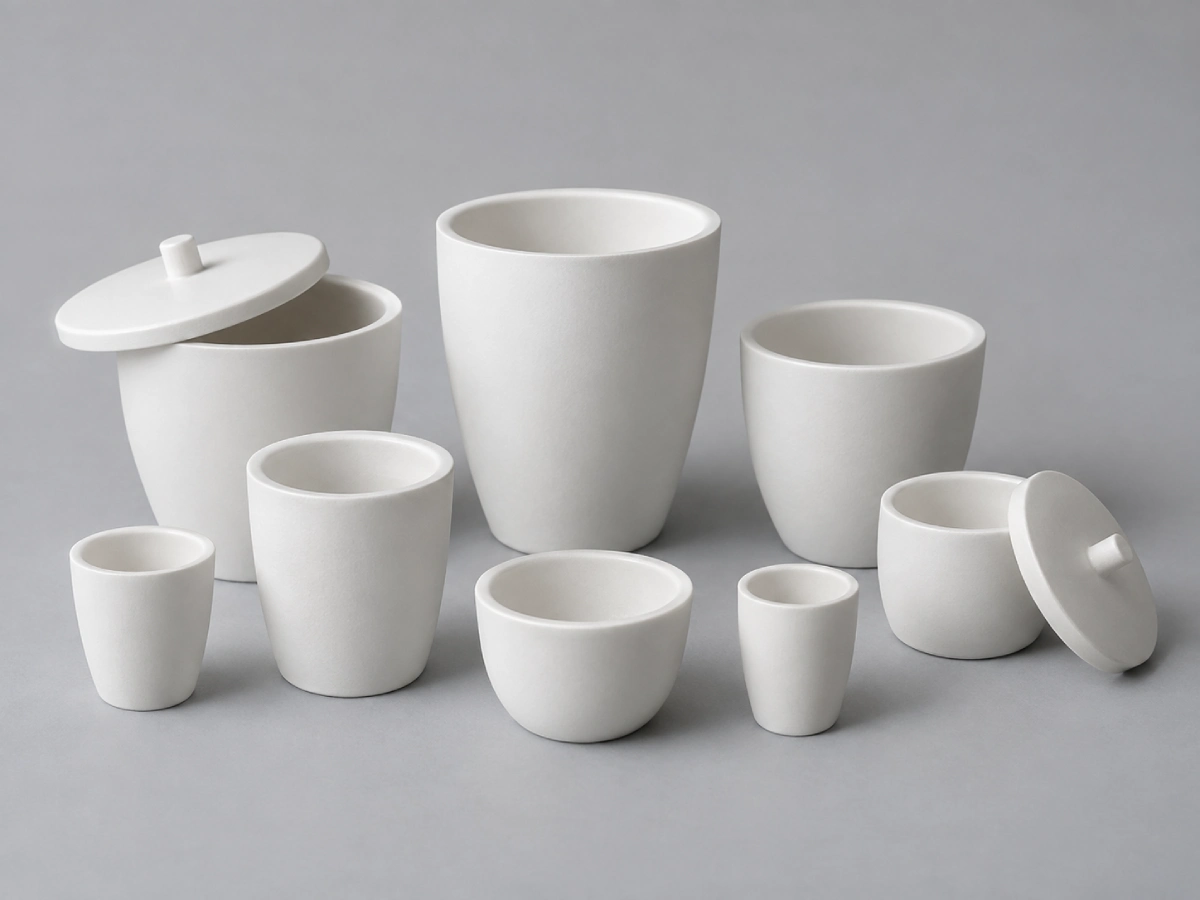
High-Temperature Duty
High-Temperature Ceramic Crucibles
Developed for thermal-processing applications where structural stability and resistance to repeated heating are essential.
View Product →Precision ceramic crucibles for melting, calcination, evaporation, heat treatment and laboratory processing. Crucible performance depends on material compatibility, thermal cycling, wall design, base geometry and the way the vessel is heated, supported and cooled.
A crucible for routine laboratory heating is selected differently from one used for molten materials, repeated thermal cycling or controlled evaporation. Start with the process conditions.
For processes where the crucible contains molten or softened material and must resist chemical attack and thermal stress.
For powder, mineral and sample processing where stable shape and clean containment are important during heating.
For controlled heating environments where purity, thermal behavior and compatibility with the processed material matter.
For repeated sample preparation and testing where dimensional consistency and material cleanliness support reliable results.
UNIPRETEC supplies ceramic crucibles for laboratory, thermal-processing and custom industrial applications with geometry and material matched to the actual process environment.
Developed for thermal-processing applications where structural stability and resistance to repeated heating are essential.
View Product →Used for process media requiring stable ceramic containment and careful material compatibility at elevated temperatures.
View Product →Suitable for sample heating, calcination and analytical workflows requiring repeatable geometry and clean handling.
View Product →Designed for controlled heating applications where thermal response, material purity and stable containment matter.
View Product →Used where a cover helps control contamination, heat retention, material loss or process atmosphere during heating.
View Product →Manufactured to drawing with custom capacity, wall thickness, rim, base and process-specific geometry for specialized equipment.
View Product →A crucible may tolerate a high furnace temperature yet still perform poorly if the process material reacts with the ceramic, wets the surface or creates damaging thermal gradients.
The melt, powder or sample must be compatible with the ceramic under the real process temperature and atmosphere.
Direct flame, furnace, induction-assisted systems and localized heating create different thermal gradients and stress conditions.
Repeated heat-up and cool-down cycles may be more demanding than a single maximum-temperature exposure.
How the crucible is supported at the base or rim influences stress distribution during heating and loading.
Crucible geometry affects thermal response, usable volume, strength and process handling. The wall, base and rim should be specified together rather than as isolated dimensions.
Crucible material should be selected according to what is processed, how it is heated and how often the vessel cycles between hot and cold conditions.
A common option for laboratory and industrial thermal processing where high-temperature stability and chemical resistance are required.
Useful where higher toughness or specific thermal and chemical behavior is needed in more demanding applications.
Relevant for selected high-temperature applications where machinability and material-specific non-wetting behavior are useful.
Alternative ceramic materials may be selected where purity, atmosphere, melt compatibility or thermal-shock performance drives the design.
Crucible reliability is often controlled by thermal gradients, process chemistry and handling conditions rather than by room-temperature strength alone.
Rapid heating or cooling can create large temperature gradients between the wall, base and rim. Heating and cooling rates should reflect the material and geometry.
A process material may react with, penetrate or wet the crucible surface at temperature. Compatibility should be reviewed using real media and process conditions.
Point support, hard clamping or poor base contact can concentrate stress during heating. The fixture and support condition should be considered with the crucible design.
Ceramic crucibles are used where clean containment, chemical stability and reliable behavior at elevated temperature directly affect process results.
Crucibles used for heating, ashing, calcination and analytical preparation under controlled laboratory conditions.
Containers used to hold molten or softened materials where thermal stability and process compatibility are essential.
Crucibles used for controlled heating of powders, minerals or compounds during thermal treatment and conversion processes.
Specialized crucibles used in controlled heating environments where purity and stable geometry are important.
Crucibles used to contain specimens or process media during elevated-temperature evaluation and development work.
Drawing-based crucibles with specific dimensions, lids, lips, supports or capacity requirements for specialized equipment.
For ceramic crucibles, inspection should focus on the dimensions and surfaces that affect usable volume, stable support, lid fit and handling during high-temperature processing.
Dimensions alone do not define a crucible application. Process chemistry, operating temperature, heating method, thermal cycle and support condition are all important during engineering review.
Material selection should consider the processed material, operating temperature, furnace atmosphere, thermal cycle, contamination tolerance and required service life.
Yes, custom diameters, heights, wall thicknesses, bases, lips and lid interfaces can be evaluated according to the selected material and manufacturing route.
They can be, but thermal-cycling performance depends on material, geometry, wall thickness, heating rate and cooling method. Rapid temperature changes should be reviewed carefully.
Yes, lid and cover solutions can be evaluated where process control, contamination protection, heat retention or material loss are concerns.
Provide the dimensions, required capacity, process material, operating temperature, atmosphere, thermal cycle, lid or support requirements and expected quantity.
Send your dimensions, process material and heating conditions for engineering review.