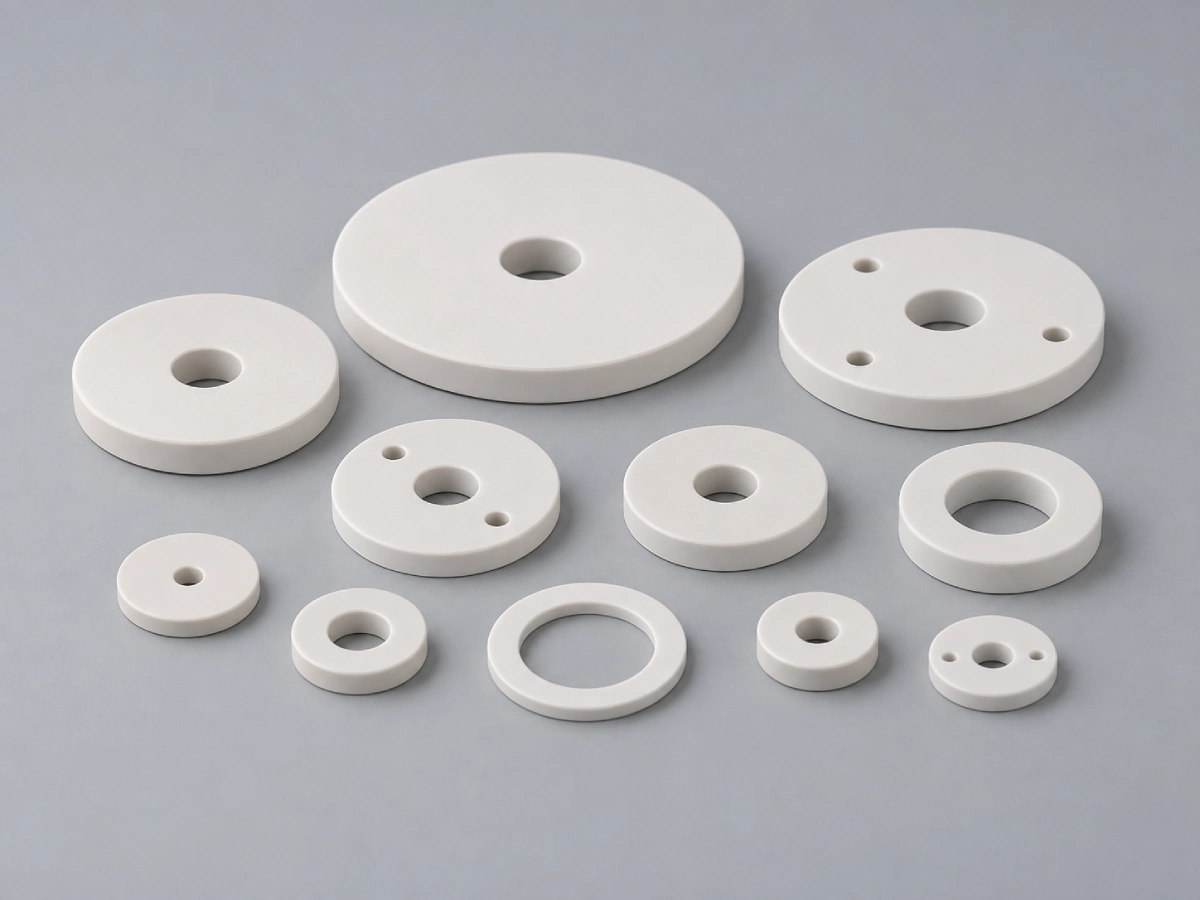
Insulation Duty
Electrical Insulating Ceramic Washers
Used where electrical separation and dimensional stability are required between conductive fasteners, housings or mounted components.
View Product →Precision ceramic washers for electrical insulation, spacing, load distribution, thermal isolation and wear-resistant interfaces. Washer performance depends on the relationship between outside diameter, inside diameter, thickness, flatness and the actual assembly load—not simply on the fact that the part is ring-shaped.
A ceramic washer used for electrical insulation is selected differently from one used to control spacing or distribute load. Start with the assembly function, then define geometry and material.
For assemblies where the washer separates conductive components and must maintain dielectric stability under mechanical clamping.
For installations where thickness and flatness control component location or create a defined stand-off distance.
For interfaces that need a hard, stable washer face to spread compressive load and protect surrounding parts.
For environments where heat, friction or repeated contact make conventional washer materials less reliable.
UNIPRETEC supplies ceramic washer solutions for insulating, spacing, fastening, thermal and custom industrial assemblies where geometry and material stability matter.
Used where electrical separation and dimensional stability are required between conductive fasteners, housings or mounted components.
View Product →Selected for assemblies where controlled thickness, flatness and concentricity help maintain repeatable positioning.
View Product →Suitable for compressive interfaces where a hard washer surface helps distribute clamping force and protect adjacent parts.
View Product →Used where thermal stability and resistance to heat-related deformation are important in the installed assembly.
View Product →Applied where repeated contact, friction or abrasive exposure can shorten the service life of conventional washer materials.
View Product →Manufactured to drawing with custom OD, ID, thickness, flatness and material requirements for specialized OEM equipment.
View Product →A washer may look simple, but performance depends on how it sits in the stack, how load enters the part and whether the ID, OD and thickness are matched to the assembly.
Controls fit around the fastener, pin or shaft and influences how load is transferred into the washer.
Affects support area and how effectively the washer distributes clamping or compressive force.
Important when the washer also functions as a spacer, stand-off or dimensional control element.
Influence seating quality, contact stability and the behavior of stacked or clamped assemblies.
The right washer specification should reflect how the part is installed and loaded. Electrical, spacing and wear-related duties often require different priorities even when the geometry looks similar.
Ceramic washer material should match the actual assembly conditions, including dielectric demand, clamping load, thermal exposure and expected wear.
A practical option for electrical insulation, dimensional stability and many general industrial ceramic washer applications.
Useful where higher toughness, damage resistance or more demanding mechanical conditions are involved.
Relevant for mechanically demanding or thermally challenging assemblies where strength and stability are important.
Alternative ceramic materials may be selected where purity, corrosion resistance or specialized performance is required.
Washer problems often begin at the interface. The surrounding hardware and the way the washer is loaded are just as important as the material itself.
If load enters the washer unevenly or through a sharp interface, local stress can rise quickly and reduce service reliability.
A washer with the wrong support area or clearance can lose stability in the assembly and fail to deliver the intended insulation or spacing function.
When a washer also sets position, even a small thickness mismatch can affect preload, alignment or overall assembly height.
Ceramic washers are used where electrical isolation, dimensional control, heat resistance or interface durability directly affect assembly performance.
Insulating washers used to separate conductive parts and maintain dimensional stability under fastening loads.
Washer components used where thickness and flatness help control spacing or positioning in an assembly.
Hard, stable washer surfaces used to protect mounted parts and spread clamp load more effectively.
Ceramic washers selected where heat resistance and thermal stability are more reliable than conventional materials.
Used where repeated contact or friction makes wear resistance a practical requirement for longer service life.
Precision ceramic washers supplied to drawing for specialized industrial, electronic and process equipment.
For ceramic washers, inspection should focus on the dimensions and surfaces that affect how the part fits, seats and performs in the installed stack.
OD, ID and thickness are only part of the picture. The fastener size, clamping method, insulation requirement and working environment all help determine the most suitable washer solution.
Ceramic washers are commonly used for electrical insulation, spacing, load distribution, thermal isolation and wear-resistant interfaces in demanding assemblies.
Yes, ceramic washers can be manufactured to drawing or specified dimensions where the geometry, material and tolerances are clearly defined.
The best material depends on the assembly duty. Electrical, thermal and mechanical requirements should all be reviewed before selecting the final ceramic.
Yes, ceramic washers are often selected for elevated-temperature applications because of their dimensional stability and resistance to heat-related degradation.
Provide the OD, ID, thickness, application duty, mating-part details, load condition, working environment and any known material or tolerance requirements.
Send your dimensions, assembly details and working conditions for engineering review.