Introduction
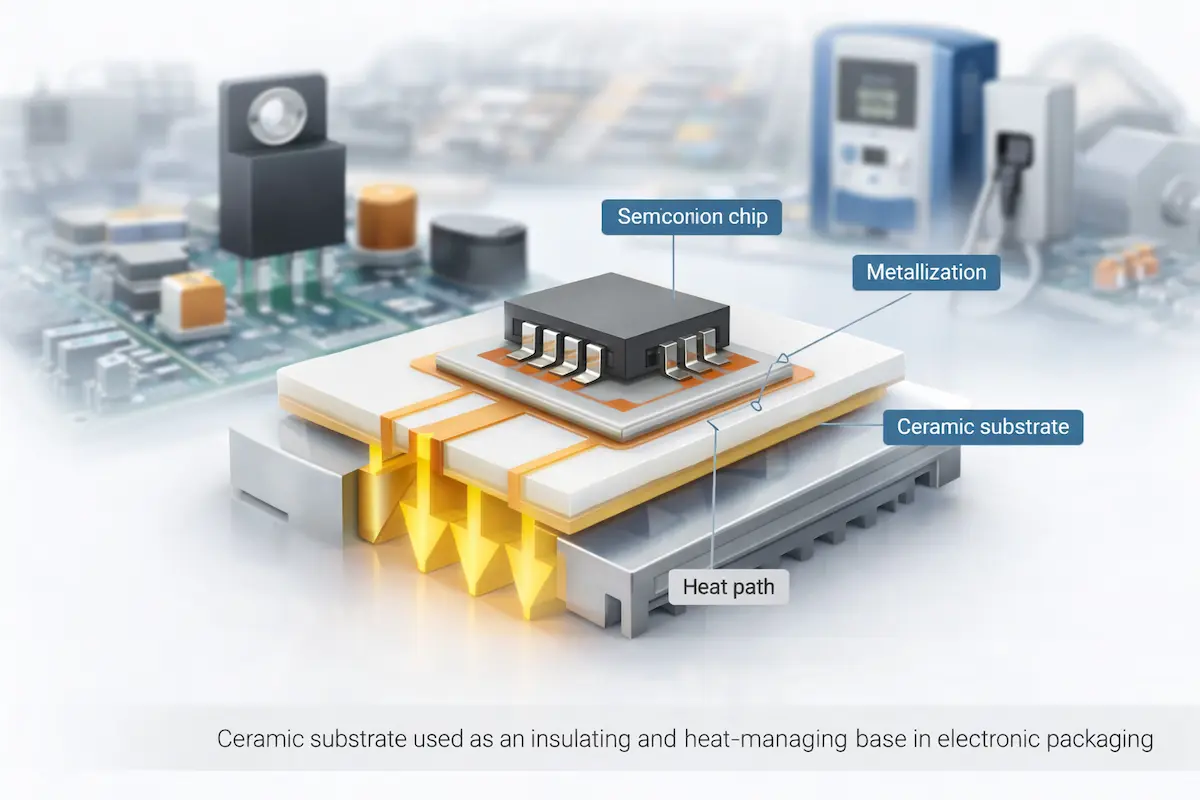
A ceramic substrate is not just an insulating plate. In engineering terms, it is a functional platform that affects thermal performance, electrical insulation, dimensional stability, reliability, and downstream assembly yield.
That is why this topic matters to engineers, sourcing teams, and OEM buyers. The wrong substrate can create heat buildup, solder joint stress, dielectric failure, metallization problems, or unnecessary cost. The right one can improve package reliability, enable compact designs, and support stable performance under demanding operating conditions.
This guide explains what a ceramic substrate is, why it matters, the main material types, the key properties that drive selection, where these substrates are used, and how to choose one based on real engineering trade-offs. It is written as a pillar page, so you can use it as a decision starting point before moving into deeper material comparisons, application-specific design work, or supplier evaluation.
What Is a Ceramic Substrate?
A ceramic substrate is a dense, flat component made from technical ceramics such as alumina, aluminum nitride, zirconia, beryllium oxide, or silicon nitride. It serves as a base for circuits, semiconductor devices, heaters, sensors, LEDs, RF components, or hybrid assemblies.
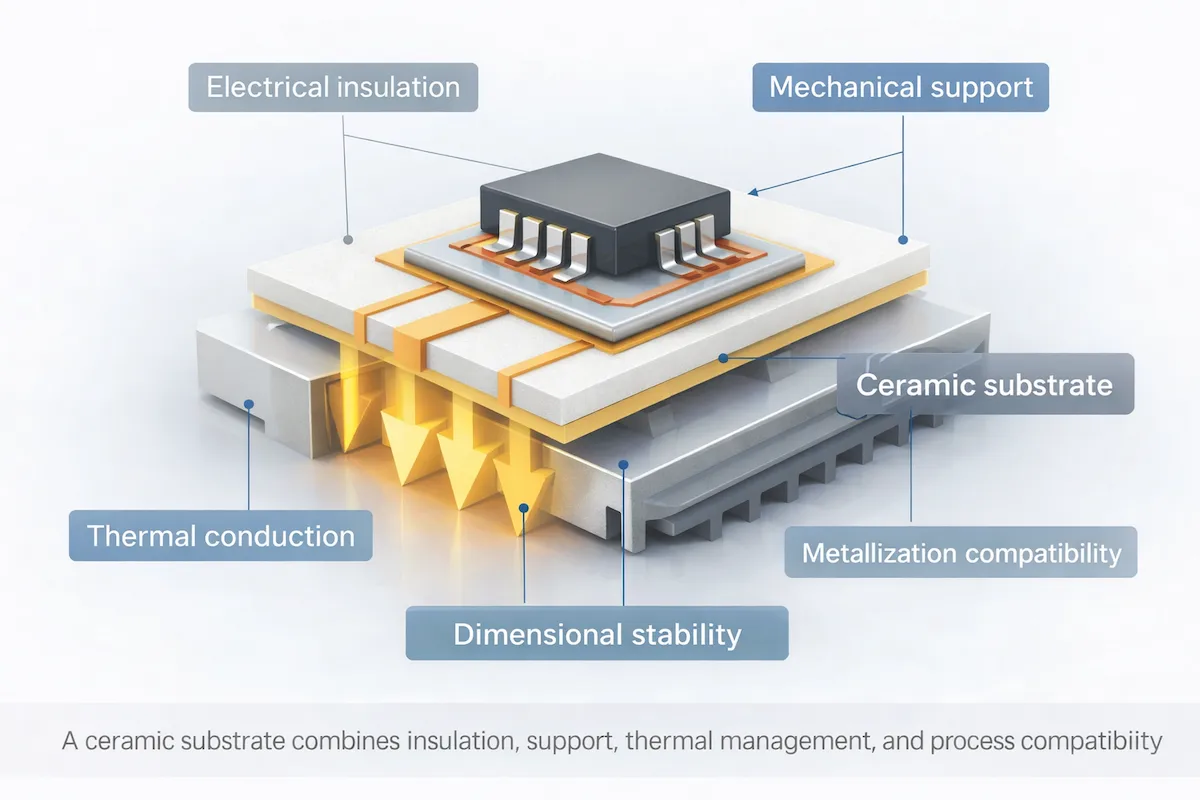
Unlike polymer-based boards, ceramic substrates combine several functions in one part:
- electrical insulation
- mechanical support
- thermal conduction or thermal control
- dimensional stability
- compatibility with metallization and thin- or thick-film processing
In practical terms, a ceramic substrate sits between an active device and the rest of the system. It helps move heat away, keeps conductive paths isolated, maintains flatness, and survives processing conditions that would damage conventional organic materials.
Conclusion: A ceramic substrate is best understood as a structural and functional platform for high-performance electronics, not simply as a replacement for a standard PCB.
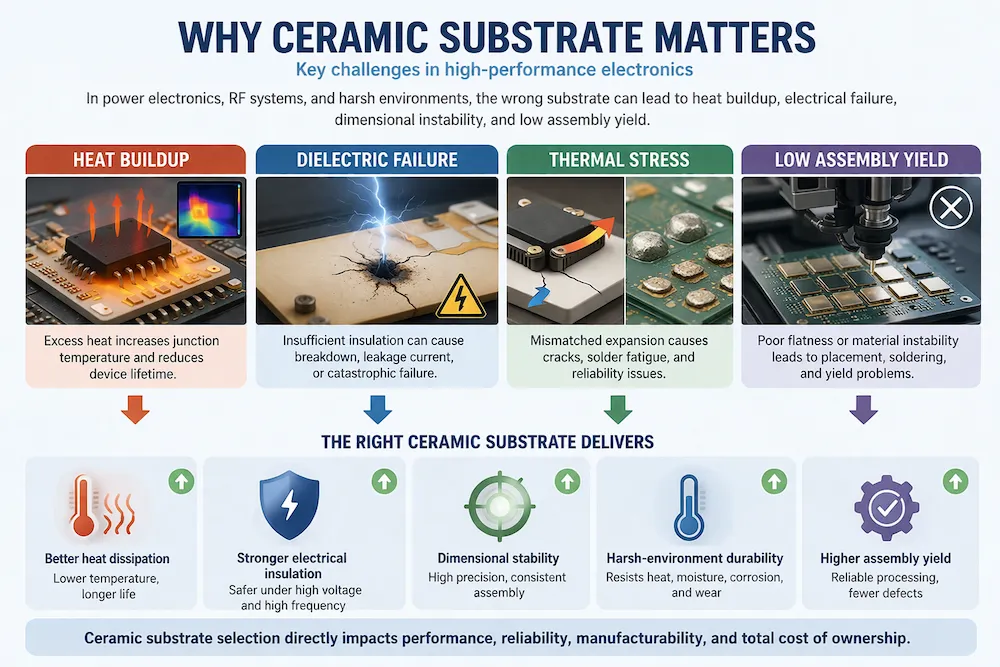
Why Ceramic Substrate Matters in Engineering and Procurement
For many buyers, the first question is not “What is ceramic substrate?” but “Why should I care?”
The answer is simple: substrate choice affects performance, reliability, manufacturability, and cost at the same time.
Thermal management
Heat is one of the main failure drivers in power electronics, LED modules, IGBT packages, laser systems, and automotive control units. A substrate with higher thermal conductivity lowers junction temperature and improves service life.
Electrical insulation under load
Ceramics offer strong dielectric insulation even under high voltage, high frequency, or harsh environmental conditions. That matters in EV power modules, industrial inverters, and medical electronics.
Dimensional stability
Ceramic materials remain stable across temperature swings and do not soften like polymer boards. This improves pattern accuracy, assembly consistency, and long-term reliability.
Harsh-environment durability
Many advanced ceramics resist corrosion, wear, moisture, and elevated temperatures better than organic alternatives. This expands their use in industrial, automotive, aerospace, and sensing applications.
Better fit for engineered assemblies
For custom ceramic components and hybrid circuits, the substrate is often part of the functional design itself. It may include drilled holes, cavities, printed conductors, brazed metal layers, or custom geometries that standard FR-4 cannot provide.
For procurement teams, this means ceramic substrate selection is rarely a pure material purchase. It is a design-risk decision that affects yield, field reliability, and total lifecycle cost.
Conclusion: Users need to pay attention to ceramic substrate selection because it directly influences heat, voltage tolerance, assembly stability, and failure risk.
Types of Ceramic Substrate Materials
Different ceramics solve different problems. No single material is best in every case.
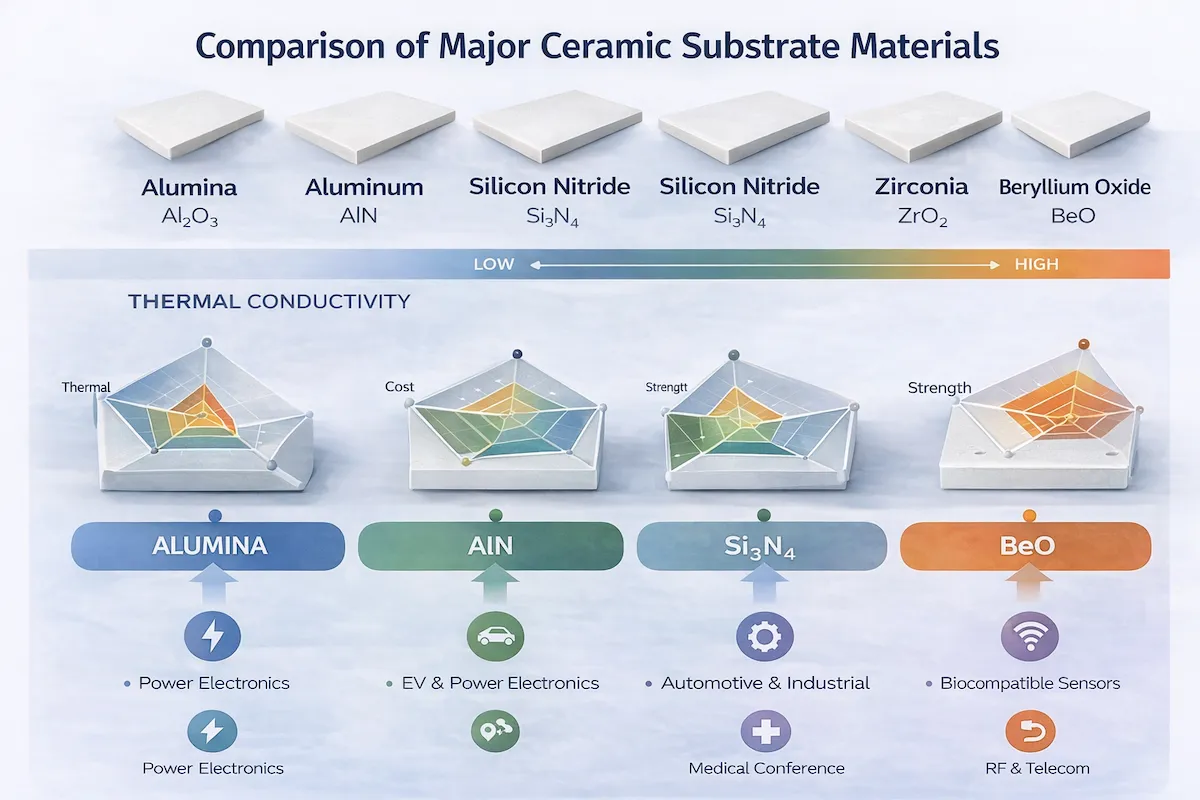
Main Ceramic Substrate Materials
| Material | Typical Thermal Conductivity (W/m·K) | Typical CTE (ppm/°C) | Strengths | Main Limitations | Common Uses |
|---|---|---|---|---|---|
| Alumina (Al₂O₃, 96%–99.6%) | 20–30 | 6.5–8.0 | Cost-effective, mature processing, good insulation, widely available | Moderate thermal conductivity | Thick-film circuits, sensors, LED modules, general electronic packaging |
| Aluminum Nitride (AlN) | 140–180 | 4.3–5.3 | High thermal conductivity, good electrical insulation, silicon-compatible CTE | Higher cost, tighter processing requirements | Power electronics, laser packages, high-power LEDs, RF modules |
| Silicon Nitride (Si₃N₄) | 70–95 | 2.8–3.5 | High mechanical strength, thermal shock resistance, crack resistance | More expensive than alumina, less common for general-purpose use | EV power modules, DBC/AMB substrates, high-reliability assemblies |
| Zirconia (ZrO₂) | 2–3 | 9–11 | High toughness, wear resistance, strong mechanical behavior | Low thermal conductivity | Sensor parts, structural ceramic components, specialty assemblies |
| Beryllium Oxide (BeO) | 200–250 | 7–8 | Excellent thermal conductivity and insulation | Toxicity concerns, restricted handling | Legacy high-power and microwave applications |
Alumina substrate
Alumina substrate is the most widely used option because it balances cost, availability, machinability, insulation, and process maturity. It is often the first choice for general electronics, sensors, resistor networks, and thick-film hybrids.
AlN substrate
An AlN substrate is selected when heat flow is a primary design constraint. Its thermal conductivity is far higher than alumina, while its thermal expansion is closer to silicon. That makes it a strong fit for chip packaging and high-power density modules.
Silicon nitride substrate
Silicon nitride has become increasingly important in high-reliability power electronics because it offers a rare combination of respectable thermal conductivity and superior mechanical robustness. In demanding automotive environments, that combination matters more than raw conductivity alone.
Conclusion: Material choice should start with the dominant engineering constraint: cost, heat, strength, or reliability.
Key Properties of a Ceramic Substrate
Engineers should not evaluate ceramic substrates by name alone. The relevant question is which property actually controls performance in the target application.
Key Selection Parameters
| Property | Why It Matters | Typical Decision Impact |
|---|---|---|
| Thermal conductivity | Controls heat spreading and junction temperature | Higher values favor power devices and dense assemblies |
| Coefficient of thermal expansion (CTE) | Affects mismatch stress with silicon, copper, solder, and packages | Lower mismatch improves reliability during thermal cycling |
| Dielectric strength | Determines insulation performance at high voltage | Critical for power modules and isolation structures |
| Flexural strength | Indicates resistance to bending or fracture | Important in handling, assembly, and vibration environments |
| Surface roughness / flatness | Affects printing, metallization, die attach, and soldering | Poor flatness can reduce yield |
| Volume resistivity | Supports electrical isolation | Important in HV and precision electronics |
| Thermal shock resistance | Reflects survival during fast temperature change | Relevant for automotive, aerospace, and power cycling |
| Process compatibility | Determines fit with DBC, AMB, thick film, thin film, LTCC, HTCC | Can limit feasible manufacturing routes |
Why thermal conductivity matters
If a design must dissipate heat from a semiconductor die, LED chip, or resistor network, thermal conductivity becomes a primary selection metric. Lower thermal resistance reduces hot spots and helps maintain performance consistency.
Why CTE matters
A substrate does not work alone. It is bonded to metals, solders, chips, and housings. If those materials expand at different rates, cyclic stress builds at the interfaces. That is why CTE matching matters just as much as heat flow in long-life designs.
Why mechanical strength matters
Some applications face vibration, pressure, assembly force, thermal cycling, or repeated power cycling. In such cases, a mechanically stronger ceramic may outperform a more thermally conductive but more brittle option.
Conclusion: The most important ceramic substrate property is not universal; it depends on which failure mode dominates the application.
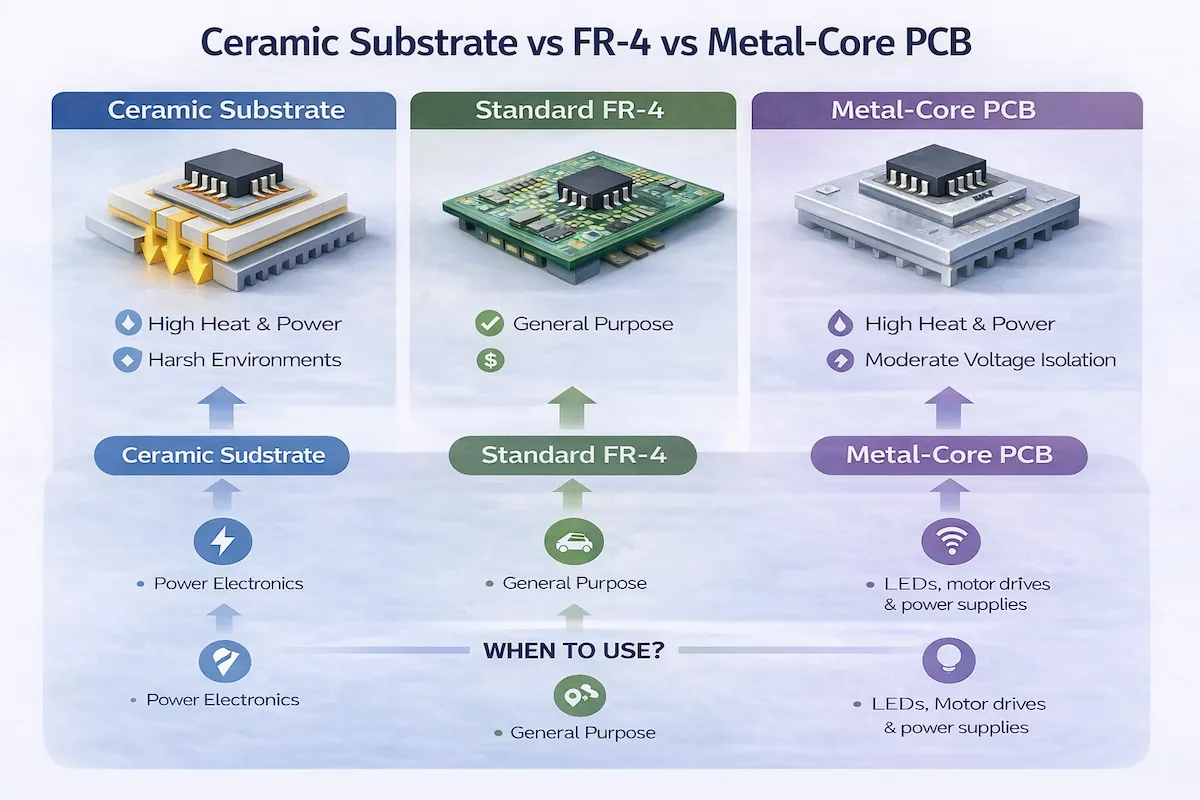
Ceramic Substrate vs Standard PCB Materials
A ceramic substrate is often evaluated against FR-4, IMS, or metal-core boards. This comparison is useful because it shows where ceramic adds real value.
Ceramic Substrate vs FR-4 / Metal-Core Boards
| Criteria | Ceramic Substrate | FR-4 PCB | Metal-Core PCB / IMS |
|---|---|---|---|
| Thermal conductivity | Medium to very high depending on material | Low | Better than FR-4 but limited by dielectric layer |
| Electrical insulation at temperature | Excellent | Moderate | Good, depends on structure |
| High-temperature stability | Excellent | Limited | Better than FR-4, still polymer-dependent |
| Dimensional stability | High | Moderate | Moderate |
| CTE compatibility with chips | Better for many semiconductor packages | Poorer | Moderate |
| Harsh-environment durability | High | Limited | Moderate |
| Cost | Higher | Low | Mid-range |
| Design complexity for simple electronics | Often unnecessary | Excellent | Good |
FR-4 remains the standard choice for cost-sensitive, low- to medium-performance electronics. A ceramic PCB substrate becomes attractive when the design requires thermal stability, insulation, miniaturization, or long-term reliability beyond what polymer systems can comfortably deliver.
That does not mean ceramic is always better. For low-power consumer electronics, ceramic may add cost without adding enough system value.
Conclusion: Ceramic substrate is justified when heat, voltage, stability, or reliability requirements exceed the capability of conventional PCB materials.
Common Applications of Ceramic Substrates
Ceramic substrates are used where electrical, thermal, and mechanical requirements intersect.
Power electronics
IGBT modules, MOSFET packages, inverters, converters, and EV traction systems rely on ceramic substrates for electrical isolation and heat transfer. Silicon nitride and aluminum nitride are common choices here.
LED and laser systems
High-brightness LEDs and laser packages generate localized heat. A substrate with better thermal performance helps protect optical efficiency, color stability, and lifetime.
Sensors and industrial controls
Pressure sensors, gas sensors, flow sensors, and heater circuits often use alumina because it handles thermal cycling, supports printed conductors, and remains stable in industrial conditions.
RF and microwave electronics
Certain ceramic materials support better dielectric behavior, dimensional stability, and thermal performance than organic laminates in demanding RF structures.
Medical and aerospace electronics
These sectors value predictable material behavior, long-term reliability, and performance under sterilization, vibration, or temperature stress.
Hybrid circuits and custom assemblies
A ceramic substrate manufacturer may supply custom geometries with metallized traces, vias, laser-cut slots, cavities, or bonded copper layers for OEM ceramic solutions. In these designs, the substrate is part of the system architecture rather than a commodity part.
Conclusion: Ceramic substrates are most valuable in applications where failure from heat, voltage, or instability is more expensive than the material itself.
Common Mistakes Buyers Make When Choosing Ceramic Substrates
In real-world sourcing scenarios, many buyers focus too heavily on initial cost while overlooking critical performance factors. This often leads to unexpected failures, redesign costs, and long-term reliability issues.
One of the most common mistakes is selecting alumina substrates for applications that actually require higher thermal conductivity. While alumina is cost-effective, it may not dissipate heat efficiently in high-power systems, resulting in overheating and reduced component lifespan.
Another frequent issue is ignoring CTE mismatch. When the substrate expands at a different rate than the chip or metal layer, it creates stress during thermal cycling, which can lead to cracking, delamination, or solder joint failure.
Buyers also tend to underestimate the importance of process compatibility. A material that performs well on paper may not be suitable for DBC, AMB, or thin-film processes, limiting manufacturing feasibility and yield.
Conclusion: The biggest risks in ceramic substrate selection come not from the material itself, but from mismatched application requirements, overlooked thermal constraints, and insufficient evaluation of supplier capabilities.
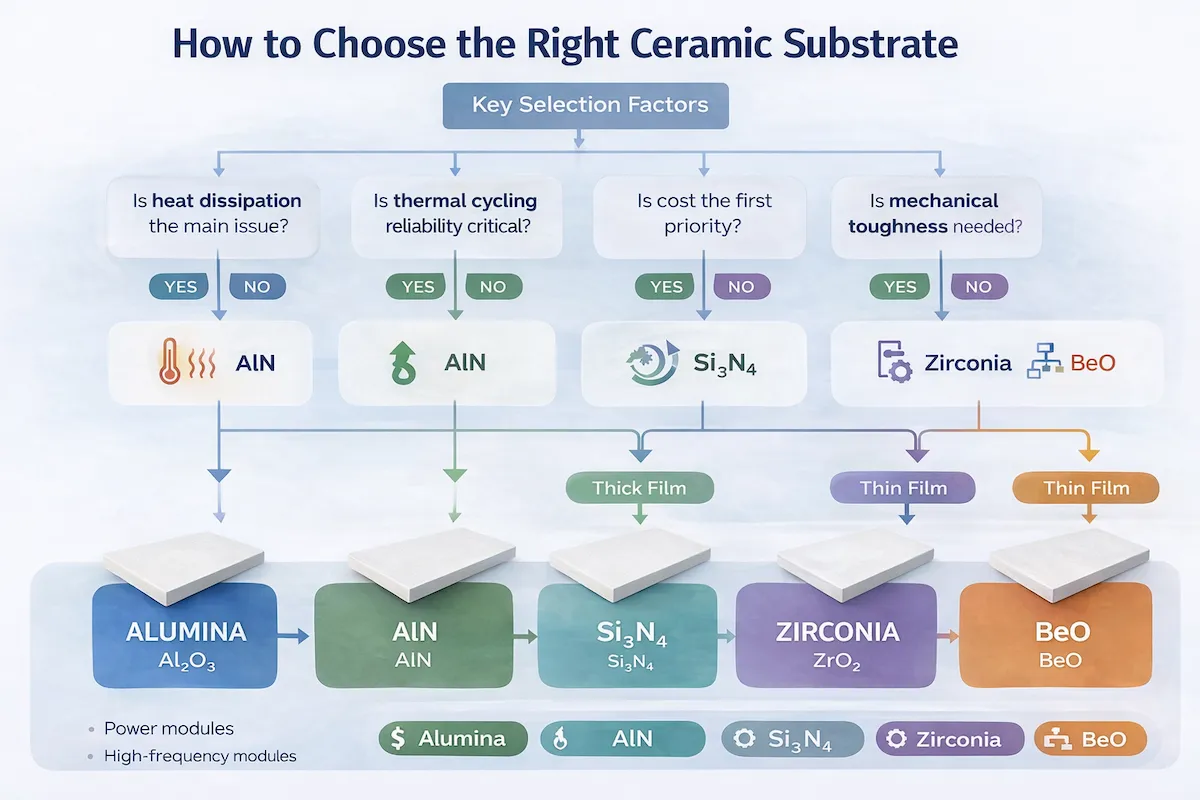
How to Choose the Right Ceramic Substrate
Selection should follow engineering priorities rather than catalog familiarity.
Step 1: Define the dominant constraint
Ask which issue matters most:
- heat dissipation
- voltage isolation
- thermal cycling reliability
- mechanical strength
- miniaturization
- cost target
The answer narrows the field quickly.
Step 2: Match material to failure risk
If heat is the bottleneck, compare alumina, AlN, and silicon nitride. If cracking or vibration is the concern, strength and fracture behavior may outweigh raw conductivity.
Step 3: Check process compatibility
Substrate performance depends on the full stack:
- thick-film or thin-film metallization
- DBC or AMB copper bonding
- soldering or brazing profile
- die attach method
- machining tolerance
- required flatness and surface finish
A material that looks ideal on paper may be difficult or expensive in the required process route.
Step 4: Evaluate total cost, not only unit price
Lower-cost material with worse thermal behavior may require larger heat sinks, more spacing, lower power density, or more redesign effort. Higher-cost ceramic can still reduce overall system cost.
Step 5: Validate with the real application
Shortlist materials using datasheets, then validate through:
- thermal simulation
- insulation testing
- power cycling or thermal cycling
- solderability and metallization checks
- prototype assembly trials
Practical Material Selection Guide
| If your priority is… | Usually start with… | Why |
|---|---|---|
| Lowest cost with good baseline performance | Alumina | Mature supply chain and broad usability |
| Maximum heat dissipation with insulation | Aluminum nitride | High thermal conductivity and chip-friendly CTE |
| High reliability under power cycling | Silicon nitride | Better mechanical durability and crack resistance |
| Wear resistance or mechanical toughness in specialty parts | Zirconia | Strong structural behavior |
| Legacy high-power thermal performance | BeO | Excellent properties, but restricted by safety concerns |
Conclusion: Good ceramic substrate selection comes from identifying the real failure mode first, then balancing material performance, process fit, and lifecycle cost.
Standards, Quality, and Supplier Considerations
For industrial buyers, technical data alone is not enough. Supplier capability matters.
When reviewing a ceramic substrate supplier, check:
- material grade consistency
- density and porosity control
- metallization capability
- flatness tolerance
- surface finish quality
- dimensional tolerances
- incoming inspection records
- traceability and process stability
Depending on the product, relevant reference frameworks may include IEC requirements, IPC-related packaging expectations, ASTM material testing methods, and manufacturer-specific quality systems such as ISO 9001 or IATF 16949 for automotive supply chains.
If you need custom ceramic components, the supplier should also understand drawing interpretation, co-design feedback, prototype iteration, and downstream assembly constraints. A capable ceramic substrate manufacturer does more than ship blanks; it helps reduce design-to-production risk.
Conclusion: In ceramic substrate sourcing, supplier process control is often as important as material selection.
Next Decision Paths After This Guide
This topic should lead to the next engineering question, not stop at definition level.
Based on your current stage, the next useful topic is usually one of these:
- Material selection path: Alumina vs AlN vs silicon nitride
- Application path: ceramic substrate for power modules, LEDs, sensors, or RF devices
- Process path: DBC vs AMB vs thick film vs thin film
- Supplier path: how to evaluate a ceramic substrate manufacturer for OEM ceramic solutions
- Reliability path: CTE mismatch, thermal cycling, and metallization failure mechanisms
That is the practical decision entry point. Once you know why ceramic substrate matters in your design, the next step is to compare materials or processes around your exact operating conditions.
Conclusion
A ceramic substrate is a high-performance base material used to support circuits and components while providing electrical insulation, thermal management, and dimensional stability. It becomes important when standard PCB materials no longer meet the requirements of heat, voltage, reliability, or harsh-environment use.
For most projects, the real decision is not whether ceramic is “good,” but which ceramic is appropriate. Alumina offers cost-effective versatility. Aluminum nitride addresses thermal constraints. Silicon nitride supports demanding reliability conditions. The right choice depends on the failure mode you need to prevent.
If you are building a theme hub around this topic, the next layer should focus on material comparison, application-specific substrate design, or supplier selection for custom ceramic components. That is where a general understanding turns into an engineering decision.
FAQ
What is the main purpose of a ceramic substrate?
The main purpose of a ceramic substrate is to provide electrical insulation, structural support, and thermal control for electronic or electro-mechanical assemblies. It is used when heat, voltage, stability, or reliability requirements exceed what standard organic boards can deliver.
What is the difference between an alumina substrate and an AlN substrate?
An alumina substrate is more cost-effective and widely used for general electronics, while an AlN substrate offers much higher thermal conductivity and better CTE compatibility with silicon. Alumina fits broader standard applications; AlN fits higher-power and heat-sensitive designs.
Is a ceramic substrate better than FR-4?
A ceramic substrate is better than FR-4 for high heat, high voltage, and high-reliability environments. FR-4 is still the better choice for many low-cost, lower-performance electronics because it is easier and cheaper to process.
Where are ceramic substrates commonly used?
Ceramic substrates are commonly used in power electronics, LED modules, sensors, RF devices, hybrid circuits, medical electronics, automotive systems, and aerospace assemblies where thermal and electrical performance matter.
How do I choose the right ceramic substrate material?
Choose the right ceramic substrate by identifying the main design constraint first, such as heat dissipation, mechanical strength, insulation, thermal cycling, or cost. Then compare materials based on thermal conductivity, CTE, strength, process compatibility, and total system cost.
References
- CoorsTek — Technical Ceramics Material Properties
- Kyocera — Ceramic Substrates and Electronic Packaging Materials
- CeramTec — Engineering Ceramics for Electronics and Power Applications
- Maruwa — Alumina and Aluminum Nitride Substrate Data
- Rogers Corporation — High-Frequency and Thermal Management Material Resources
- IEC standards related to electronic insulation and component reliability
- ASTM material test methods for ceramic mechanical and thermal characterization
- IPC documents related to electronic packaging and substrate-related assembly practices
How to Choose a Reliable Ceramic Substrate Supplier
Selecting the right material is only part of the decision. The capabilities of the ceramic substrate manufacturer play a critical role in achieving consistent performance and production reliability.
Buyers should evaluate whether the supplier has experience with relevant manufacturing processes such as DBC, AMB, thick-film, or thin-film technologies. Process capability directly impacts metallization quality, bonding strength, and overall product performance.
Customization is another key factor. Many applications require specific dimensions, surface finishes, laser machining, or multilayer structures. A qualified ceramic substrate supplier should be able to support these requirements without compromising consistency.
In addition, quality control systems, material traceability, and production stability are essential for high-reliability applications such as power electronics, automotive systems, and medical devices.
Conclusion: A reliable supplier is not just a material provider, but a technical partner that ensures your ceramic substrate performs as expected in real-world conditions.
How to Avoid Costly Mistakes When Selecting Ceramic Substrates
Many buyers focus only on price when sourcing ceramic substrates. However, ignoring thermal performance, CTE compatibility, and process capability often leads to system failure, higher long-term costs, and unstable product performance.
To reduce these risks, it is essential to evaluate not only the material itself but also the supplier’s manufacturing capability, customization support, and experience in similar applications.
If you are working on power electronics, LED modules, or high-reliability systems, selecting the right substrate early can significantly improve performance and reduce failure rates.
👉 Need help selecting the right ceramic substrate for your project?
You can request material recommendations, samples, or technical support based on your application requirements.
Quick Recommendation: If your application involves high heat, choose AlN or silicon nitride. If cost and scalability are priorities, alumina is usually the best starting point.